


Despite the uncertainty surrounding the review of the United States-Mexico-Canada Agreement (USMCA), investments continue to flow into northern Mexico; however, to further capitalize on these opportunities, Mexico must accelerate the development of logistics infrastructure, strengthen its energy supply, and guarantee legal certainty for investors .
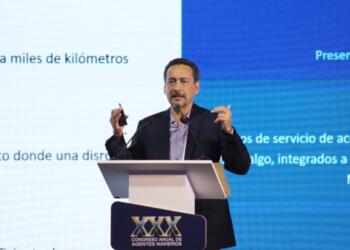
Alejandro Doria, president of the Northeast Chapter of the American Chamber of Commerce of Mexico (AmCham) , said that the main challenge is no longer just attracting new investments, but providing the country with the necessary conditions to sustain the growth of supply chains in North America.
“We need to continue developing ports, airports, highways, railways and intermodal terminals that allow for more efficient logistics between Mexico, the United States and Canada,” he said in an interview with T21.
He highlighted that various actions have been carried out, such as the entry into operation of the second international rail bridge between Nuevo Laredo and Laredo, as well as the construction of a new multipurpose rail terminal in Pesquería, Nuevo León, a Bulkmatic project , which contemplates an investment of 150 million dollars and a capacity to receive up to 1,400 railcars.
However, he considered it essential to move forward with standardizing customs and inspection processes on both sides of the border. “Any delays at border crossings mean costs for businesses. Trade facilitation must accompany infrastructure investments,” he stated.
Regarding regulatory reforms in Mexico, he considered that some, such as the possible increase in payments for railway concessions, would have a limited impact on end users, although he acknowledged that they generate concern within the sector.
However, he considered the availability of electricity and natural gas, especially in the northeast of the country, to be a more relevant challenge.
Energy, the main bottleneck
According to the executive, the lack of electrical distribution infrastructure currently represents one of the biggest risks to the arrival of new industrial investments.
“More than customs, it’s the lack of infrastructure, for example, energy, that can put a bit of a brake on investment. The Mexico Plan includes a budget section for investing in energy, although most of it doesn’t go to distribution, which is the last mile, and that’s where we have the problem: getting it directly to the industrial parks and factories,” he emphasized.
He also mentioned Mexico’s dependence on natural gas from Texas , a situation that exposes the national industry to disruptions resulting from weather events or problems in the US supply, leading to a halt in production.
“The proposal is that we continue investing in infrastructure; we need more pipelines. It’s already in the budget. We produce enough energy, but we don’t have the infrastructure—cables, transformers—to deliver it directly to where it’s needed. Regarding gas, the government has also proposed investments with the private sector to begin fracking and start producing natural gas on this side,” he explained.
In light of the review of the USMCA, the American Chamber maintains as a priority preserving the essence of the agreement and ensuring a long-term horizon for investments.
The organization is pushing for the treaty to remain in effect for 16 years and for periodic reviews to focus on implementing existing commitments, rather than introducing new trade barriers or modifying rules of origin.
“The United States, Mexico, and Canada need to function as a bloc. The competition isn’t among ourselves, but rather with other regions of the world, particularly Asia. All companies need a long-term perspective to make investments. When we invest, we think in terms of 15, 20, or 30 years. A treaty that doesn’t give us long-term certainty makes it very difficult to continue investing, or we become more cautious because we don’t know if the rules will change next year,” he noted.
Although he acknowledged that, despite the uncertainty, companies continue to invest in Mexico, Doria noted that Nuevo León alone attracted approximately $3.7 billion in Foreign Direct Investment (FDI) during the first half of the year.
He mentioned the investments recently announced by companies such as Volvo , LEGO, and Bulkmatic, as well as additional projects that are yet to be announced.
In addition to infrastructure and energy, the business representative identified security and legal certainty as critical factors for maintaining Mexico’s competitiveness against other markets.
He acknowledged progress in Nuevo León through coordination mechanisms between state and federal authorities and the private sector, and considered that this model should be replicated in other regions of the country.
Comment and follow us on LinkedIn: @Evangelina del Toro / @GrupoT21