



In the third quarter of 2026 (3Q26), industrial construction in Monterrey grew 28% quarter-on-quarter, reaching 666,000 square meters (m²) distributed across 22 buildings, in a market that showed a reduction in vacant space and demand driven mainly by diverse manufacturing, according to the consultancy CBRE Mexico .
In its Market View report of the industrial sector in the city of Monterrey , it noted that during the July-September period, new construction starts totaled 220,000 m² , of which 85% were concentrated in three municipalities: Ciénega de Flores with 39%, Apodaca with 29% and Escobedo with 17 percent.
At the close of Q3 2026, Monterrey’s industrial inventory reached 18.11 million m² , which represented an annual increase of 5.1%, after incorporating 138,000 m² of new supply during the period.
Gross absorption , which accounts for the area sold, totaled 284,000 m² in Q3 2026, bringing the cumulative total to 710,000 m², an annual growth of 2.7 percent.
Quarterly activity was concentrated in Apodaca with 41% of the leased area, Escobedo with 29%, and Ciénega de Flores with 21%. Together, these submarkets accounted for 91% of the gross absorption for the period.
By property type, new buildings accounted for 213,000 m² , while build-to-suit projects —developed to meet a tenant’s specific needs—totaled 40,000 m². Second-generation spaces, meaning previously occupied properties, contributed 31,000 m².
Meanwhile, net absorption, an indicator that reflects the change in inventory occupancy, reached 228,000 m² during the quarter and accumulated 552,000 m² at the close of Q3 2026. However, this latter figure remains below the 787,000 m² recorded in the same period of 2025.
Increased leasing and occupancy of spaces contributed to reducing vacant space from 1.22 million to 1.11 million m² between the second and third quarters of 2026. Thus, the vacancy rate fell from 6.8 to 6.1 percent.
Apodaca saw the largest decrease in available space, with 78,000 square meters less, followed by Santa Catarina and Ciénega de Flores. In contrast, Escobedo reported an increase of approximately 12,000 square meters in its vacant area.
Despite the quarterly reduction, the vacancy rate of 6.1% is still above the 5.9% observed in the third quarter of 2025. This indicates that availability has improved compared to the previous quarter, but has not yet returned to the level of a year ago.
Additionally, 212,000 m² of subleased space was monitored, a 131% increase compared to the 92,000 m² recorded a year earlier. This indicator adds another variable to the availability analysis, as companies can offer spaces they no longer require without necessarily adding new buildings to the inventory.
Manufacturing concentrates the demand
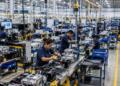
Diverse manufacturing remained the main driver of industrial real estate demand in Monterrey. During the first nine months of 2026, this segment accounted for 420,000 m² , equivalent to 59% of the cumulative gross absorption.
Logistics and transport followed with 79,000 m², representing 11% of the commercialized area, and the automotive sector with 75,000 m², equivalent to 10.5 percent.
The distribution shows that the demand for industrial spaces is mainly linked to production needs, while logistics and transport companies maintain a relevant share in the occupancy of properties for storage and operation of supply chains.
By country of origin, US companies led cumulative demand with 249,000 m² , followed by China with 104,000 m² and Mexico with 70,000 m². The average transaction size was approximately 12,900 m².
The performance of the industrial real estate market occurs in an environment where Nuevo León maintains a relevant weight in attracting investment.
During the first half of 2026, the entity received three billion 712 million dollars of Foreign Direct Investment (FDI), equivalent to 10.6% of the national total.
In Monterrey, the consulting firm identified development activity mainly linked to manufacturing projects and companies related to electronic components and supply chains associated with technological infrastructure.
Furthermore, greater clarity regarding the review process of the United States-Mexico-Canada Agreement (USMCA) could provide certainty to companies’ investment and expansion decisions.
“The Monterrey industrial market maintained its stabilization process during Q3 2026, with a recovery in net absorption and a reduction in availability,” highlighted Ramón Flores, Vice Chairman of CBRE Mexico, Northeast region.
Comment and follow us on LinkedIn: @GrupoT21