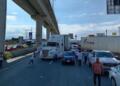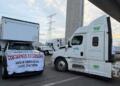



Highway insecurity was one of the main reasons for the national trucking strike , but the working group established to address it has yet to be scheduled. Although trucking organizations have already begun negotiations with the federal government, the initial meetings focused on tax issues, while labor and infrastructure matters have a defined timeline.
During a press conference held last Tuesday, October 27, representatives of the National Chamber of Freight Transportation (Canacar) , the Honorable Mexican Alliance of Transporters Organization (HAMOTAC) , the Mexican-American Federation of Transporters (FEMATRAC) and the Integrating Organization of Conventional Rights (INDECO) announced the progress of the negotiations after the lifting of the blockades.

The first meeting was held with the Ministry of Finance and Public Credit (SHCP) , with which talks will continue this Wednesday, October 28. A meeting with the Mexican Social Security Institute (IMSS) and the Ministry of Labor and Social Welfare (STPS) is scheduled for Thursday, October 29 , while on Friday, October 30, they will address infrastructure issues with the Ministry of Infrastructure, Communications and Transportation (SICT) and Federal Roads and Bridges (Capufe) , reported Augusto Ramos Melo, president of Canacar.
However, he acknowledged that there is still no date set for the installation of the security committee , which is expected to include the participation of the Secretariat of Security and Citizen Protection (SSPC) , the National Guard , and the Attorney General’s Office (FGR) .
One of the main proposals will be to strengthen anonymous reporting mechanisms, given the fear of operators and companies of suffering reprisals.
“We are afraid to file a complaint, because when we file a complaint we also face retaliation,” Ramos Melo pointed out, expressing the feelings of the operators.
Added to this is the demand to expedite the return of units recovered after a theft , because carriers reported that the vehicles can remain detained for months, even after they have been located.
For his part, Lauro Rincón Hernández, national president of FEMATRAC , explained that the timeframe for obtaining results will depend on the responses from each agency. He mentioned that periods of three, four, or five months could be expected, although he clarified that these are not yet definitive deadlines.
Division between transport organizations?
Another point addressed was the existence of parallel negotiations with business organizations such as the Confederation of Industrial Chambers (Concamin) and the National Chamber of Passenger and Tourism Transportation (Canapat) .
Representatives from Canacar, HAMOTAC, FEMATRAC, and INDECO clarified that their working groups are independent and focused on the needs of the freight transport sector, although they acknowledged that there may be some overlap in certain proposals.
Carlos García Álvarez, national president of HAMOTAC, defended the unity achieved between Canacar, HAMOTAC, FEMATRAC and INDECO, the four organizations that promoted the national strike, and questioned why the authorities had previously minimized their demands by considering that the sector was divided.
“They minimized us and saw that we were divided and saw that we didn’t have ideals, that we didn’t have the same needs,” he said.
The review of mechanisms for preventing and addressing crimes against motor transport, as well as strengthening coordination between federal and state authorities, are among the demands that will be addressed at the highway safety meeting, said Ignacio Granados Villanueva, vice president of the central region of INDECO.
Comment and follow us on LinkedIn: @Karina Quintero / @GrupoT21