PROGRESO, YUC.- The area surrounding the entrance to the fiscal pier of this port – the longest in the world – was the scene of an announcement that aims to mark a turning point in the logistics history of southeastern Mexico: the modernization of the container terminal operated by APM Terminals Yucatán , with a projected investment of just over three billion pesos over 19 years. The project, which extends the concession until 2044, seeks to transform the facility into a strategic hub capable of attracting more shipping companies, increasing operational capacity, and consolidating the region’s logistics focus.
“After a period of negotiations with the Yucatán government and the authorities, we finally reached an agreement for the modernization of the APM Terminals container terminal. We are beginning a new chapter,” said Victor Konen, general director of APM Terminals Yucatán, in an interview with specialized media.
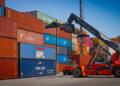
The plan isn’t limited to new cranes or port infrastructure. It includes improvements to yards, telematics systems, surveillance cameras, and enhanced security, in addition to investments in a larger-capacity cold storage facility. Konen stated that the acquisition of two additional Mobile Harbor Cranes is planned , with a manufacturing and delivery process of up to 24 months. “We want more shipping companies to come, to have more volume and more vessels at our docks,” he emphasized.
The terminal currently maintains regular services with CMA CGM , Maersk , ZIM, and Línea Peninsular , companies that have found a stable connection to international markets in Progreso. Konen emphasized that the goal of the modernization is not only to strengthen service to these shipping companies , but also to open the door to new routes and services that increase the southeast’s connectivity with the world’s main trade corridors.
According to statistics from the General Coordination of Ports and Merchant Marine (CGPMM) , the port of Progreso handled 67,967 TEUs (20-foot containers) in deep-sea services (foreign trade) during January-July 2025, which represented a growth of 7.7% compared to the same period in 2024. This dynamism, Konen added, reflects the terminal’s potential to consolidate itself as a platform with greater reach in international trade.
Beatriz Yera: confidence and competitiveness
During the formal ceremony with local authorities, Beatriz Yera, general director of APM Terminals México , spoke about the bridge between corporate vision and regional momentum. “We know that the port of Progreso is not just a space on the map, nor is it just another logistics hub. It is a strategic gateway to development, trade, and innovation . It is the gateway to a new era for Yucatán,” she stated.
He emphasized that the success of modernization depends not only on infrastructure, but also on mutual trust between companies, authorities, and the private sector. He therefore recognized entrepreneurs, customs brokers, importers, exporters, and shipping lines as the allies who sustain the port’s daily operations. “You are the logistical heart of this place,” he emphasized.
His message was also a declaration of strategic intent: to consolidate Progreso as a hub capable of attracting new maritime routes and connecting Yucatán to international trade. “Today we want to clearly state to everyone: APM Terminals is here to invest, but beyond that, to commit to the state, the city, our users, and our clients. Because the future isn’t built alone, it’s built as a team,” he expressed.
In this way, Yera presented modernization not only as a community commitment , but as a platform for competitiveness and trust that seeks to place Yucatán on the path to long-term logistics growth.
The state as guarantor of sustainability
Captain Claudia Hernández, head of the General Directorate of the Merchant Marine, representing the CGPMM, took the announcement beyond the business aspect. Her message emphasized that the modernization is not just an agreement with a global company, but a strategic public policy decision . “APM Terminals México has confirmed an investment of three billion pesos in the modernization and maintenance of its container terminal in this port. This commitment strengthens the port infrastructure and sends a clear message of confidence in Yucatán, its people, and the logistics potential of southeastern Mexico.”
Hernández emphasized that modernization means local employment and productive linkages, as more than half of the suppliers are Yucatecan and nearly 90% of the resources remain in the region , with an impact exceeding 40 million pesos annually.
With a critical perspective, he emphasized that federal ports cannot limit themselves to competing in cargo capacity, but must meet international safety and environmental standards—including ISO, CTPAT, ISPS, and the Environmental Quality Certificate from the Federal Attorney General’s Office for Environmental Protection (Profepa) —which today make a difference in global trade.
“This 19-year project demonstrates that port development requires a long-term vision and a willingness to invest to consolidate Mexico as a competitive country,” she stated. With this, the captain placed Progreso in the national debate on sustainability, inclusion, and competitiveness, emphasizing that ports are engines of development, but only if they manage to integrate infrastructure with community well-being and logistical resilience.
The port as the backbone of the “Mayan Renaissance”
The governor of Yucatán, Joaquín Díaz Mena, linked the announcement to the political narrative that has defined his administration. “Today we open a new chapter in the history of Yucatán. The port that connects us to the world begins a phase of modernization thanks to the alliance between APM Terminals and the state government, with an investment of 3.215 billion pesos,” he stated.
Beyond the figure, the president placed the Progreso terminal as a centerpiece of the so-called “Mayan Renaissance ,” a project that aims to position the state for global trade. He emphasized that modernization not only entails high-level infrastructure, but also 230 direct jobs and more than 1,100 indirect jobs, a source of well-being for families in Progreso and the state.
He emphasized that the port should be seen as an international logistics hub capable of connecting Yucatán with Europe and the Americas, opening up opportunities for local businesses and generating competitiveness for Yucatecan products. “It’s not just an investment in iron and cement; it’s an investment in our people, in the future, and in social peace,” he stressed .
Díaz Mena took the opportunity to send a message to the private sector: Yucatán is a reliable investment destination , not only for its security and social stability, but also for the vision of a government committed to growth in partnership with private enterprise. In his narrative, the port is not only an economic asset, but the backbone of his political project: a symbol of regional identity that can become a platform for global competitiveness.
Global vision, local impact
The institutional video shown during the event highlighted that APM Terminals operates more than 60 terminals in 33 countries and has been responsible for the only container terminal in Progreso since 2005. With a plan based on four pillars—infrastructure, operating equipment, technology, and sustainability—the company aims to align the facility with the demands of international trade.
The commitment to decarbonization by 2040 , the adoption of hybrid equipment, and the use of solar energy are part of the discourse that seeks to place the port on the global sustainability agenda. But beyond the announcements, the challenge is to transform these promises into tangible improvements that increase Yucatán’s competitiveness compared to larger ports like Manzanillo, Veracruz, or Lázaro Cárdenas, where multimillion-dollar investments are already the norm.
Between narrative and reality
The APM Terminals project comes at a key moment for Mexican port policy. While nearshoring demand is driving foreign trade growth, southeastern ports have historically faced infrastructure and land connectivity gaps. The modernization of Progreso could become a catalyst for new supply chains , but it will depend on the port’s ability to integrate with the productive hinterland and national logistics corridors.
By extending its concession until 2044, APM Terminals is betting on the long term. The challenge will be to maintain the community’s trust, realize the vision of shared development, and demonstrate that modernization is not limited to cranes and yards, but rather translates into decent jobs, regional competitiveness, and environmental sustainability.
In the words of Governor Díaz Mena, “the best years for Progreso are those yet to come.” Time will tell if this announcement becomes the lever that integrates the port of Yucatán into the major leagues of international maritime trade .
Comment and follow us on X: @EnriqueDuRio / @GrupoT21