The Mexican Association of Port, Maritime, and Coastal Engineering (AMIP) used its 60th anniversary to reflect on the challenges facing the nation’s maritime infrastructure and the transformations that will shape the sector’s future. During two days of workshops, specialists, authorities, academics, and industry representatives agreed that Mexico’s port competitiveness will depend on its ability to integrate technological innovation , sustainability, resilience, and data intelligence into the planning and operation of its facilities.
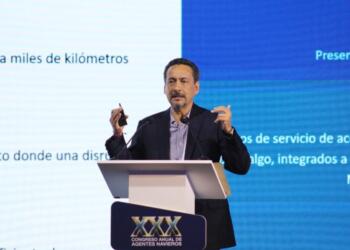
Under the motto “A Look at the Past with a Vision for the Future,” the forum brought together 130 participants and featured 13 presentations and two special panels, which analyzed topics ranging from the evolution of the national port system to the challenges associated with maritime governance, coastal engineering , logistics connectivity, and the incorporation of new technologies. The event also served to recognize the achievements of former AMIP presidents and strengthen networking opportunities among professionals in the sector.
One of the central themes of the event was the discussion on the strategic planning of the Mexican port system . The experts agreed that ports and the merchant marine remain fundamental elements for economic development and national sovereignty, and therefore, the decisions made now will have a direct impact on the country’s logistical and commercial capacity in the coming decades. The shared vision pointed to the need to promote modern, efficient, and resilient infrastructure, capable of responding to a global environment characterized by rapid technological change and increasing environmental demands.
Within this analysis, the concept of smart ports gained prominence, its evolution being linked to the development of autonomous vessels, the intensive use of advanced communication networks, edge computing tools, and increasingly sophisticated digital integration processes. Participants noted that technological transformation is already redefining international maritime competitiveness and that Mexico must accelerate its adaptation to remain relevant in global trade corridors.
AMIP’s relationship with the World Association for Waterborne Transport Infrastructure (PIANC) also featured prominently in the program. During the sessions, the progress achieved by Mexican representatives on various technical committees was presented, and the growing involvement of young professionals in international working groups was highlighted. The participation of new generations was identified as a key factor in ensuring the continuity of specialized knowledge and strengthening Mexico’s presence in global forums where trends in maritime and port engineering are discussed.
The development of port infrastructure was another key theme of the meeting. Presentations addressed the evolution of ports from traditional facilities to highly specialized logistics complexes, where the integration of maritime infrastructure, land connectivity, and supply chains is essential for improving competitiveness. In this context, the need to develop a long-term vision that aligns port growth with the needs of foreign trade and regional development was emphasized.
Experts agreed that a port’s efficiency depends not only on the installed capacity of its docks , but also on the quality of the rail, road, and logistics connections that link the terminals to their surrounding economic areas. Thus, strengthening the hinterland was identified as an essential condition for fully leveraging port investments and improving the country’s competitiveness.
Specialized engineering and resilience also featured prominently on the agenda. Discussions centered on the need to incorporate innovative methodologies for designing infrastructure capable of responding to increasingly complex environmental phenomena. The combination of strategic planning, risk assessment, and new engineering tools was presented as an essential component for ensuring the sustainability of maritime and coastal projects.
In parallel, companies supplying materials, technologies, and construction systems shared experiences and case studies in port projects. The presentations demonstrated how innovation in specialized materials , maritime security solutions, and advanced construction techniques are contributing to increased safety, durability, and efficiency of port infrastructure, in a context where projects demand ever-higher levels of technical performance.
The final stage of the forum focused on sustainability and port operations . Specialists analyzed models of specialized terminals and governance mechanisms that would improve operational efficiency without neglecting regulatory, environmental, and security aspects. The shared conclusion was that the future competitiveness of ports will depend not only on physical infrastructure but also on the institutional capacity to coordinate multiple stakeholders and establish increasingly comprehensive management frameworks.
As a result of the discussions, AMIP identified several areas of opportunity to strengthen its role as a leading technical body in the maritime-port sector . These include consolidating a formal group of young professionals, increasing participation in PIANC’s technical committees, and promoting the development of generative artificial intelligence applications for the maritime, port, and coastal sectors. These initiatives aim to strengthen knowledge generation and transfer by leveraging digital technologies, data science, and collaborative tools.
Six decades after its founding, the association used this forum to reaffirm the importance of collaboration among specialists, authorities, companies, and knowledge centers. Beyond the institutional commemoration, the main message of the meeting was that the future of Mexican ports will depend on the sector’s ability to combine technical expertise, innovation, sustainability, and the training of new generations, in an environment where technological transformation is constantly redefining the rules of global competitiveness.
Comment and follow us on LinkedIn: @Enrique Duarte Rionda / @GrupoT21