In a strategic move driven by the surge in business relocation and new trade rules under the United States-Mexico-Canada Agreement (USMCA) , the Texas government, through its Department of Transportation (TxDOT) , formally invited Guanajuato to participate in the Texas-Mexico Border Transportation Master Plan (BTMP) Update.
The presence of the state of Guanajuato was consolidated through the invitation to Héctor López Santillana, general director of Guanajuato Puerto Interior (GPI) , based on his experience and the importance of the Bajío industrial logistics platform as a key node of foreign trade.
The BTMP coordinates the movement of a 1,254-mile border and 34 international crossings , a binational network that processed a record $533 billion in trade during 2024. Given this scenario, TxDOT determined it essential to incorporate Guanajuato’s vision, given that it has the most dynamic dry port in the interior of the country, integrating it alongside the traditional border states (Nuevo León, Tamaulipas, Coahuila, and Chihuahua).
The active participation of the state in this North American plan generates direct competitive advantages for the local economy and industry:
- Guarantee of free flow: By participating in the route planning, it is ensured that exports from companies located in Guanajuato have priority access and are free of bottlenecks at international bridges.
- Nearshoring investment attraction : It consolidates the state as the most prepared inland destination to receive foreign investment, by offering logistical certainty and a direct and planned connection with the Texas market.
- Reduction of operating costs: The design of a continuous “logistics architecture” decreases transit times and optimizes intermodal transport costs for producers in the region.
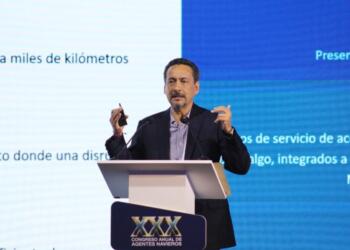
During his address to industry leaders and senior TxDOT officials, López Santillana shared his vision, emphasizing that the current challenges facing global supply chains demand a shift away from isolated efforts:
“We are not just dealing with a cross-border problem. If we don’t understand it systemically and address it comprehensively, we won’t solve the border efficiency problem. The demand for the movement of goods continues to grow, forcing us to view this as a large, continuous logistics corridor from the main market of the Valley of Mexico and the Bajío region to Texas. Otherwise, we will simply be transferring the problem further down the line ,” he emphasized.
In front of a study area that annually processes more than 5.3 million commercial vehicles and one million railway cars heading north , López Santillana presented the Guanajuato Inland Port model as a benchmark of success.
GPI, which celebrates its twentieth anniversary this year, presented itself as a unique public-private partnership that has operated entirely self-sufficiently and sustainably for the past twelve years, without requiring public funds. Home to 140 international companies, 90 percent of which operate directly in international trade, the complex represents the ideal inland engine for boosting activity at the border.
According to the official TxDOT timeline, Guanajuato ‘s intervention comes at a critical moment: the ” Projects, Strategies and Policies ” phase scheduled for May 2026.
This means that the state’s proposals will directly influence the technical agenda that will be presented for the adoption and final approval of the Master Plan in January 2027.
The proposal to transition from a purely “infrastructure” vision to a multimodal and intermodal “logistics architecture” vision was well received by US authorities.
At the close of the session, led by Claudia J. Lagos Galindo, Director of International Trade at TxDOT, Guanajuato reaffirmed its commitment to participate in the design of pilot solutions and customs technology tests that ensure binational competitiveness and security, protecting the economic flow of both nations.
Comment and follow us on LinkedIn: @GrupoT21