In light of the review of the United States-Mexico-Canada Agreement (USMCA) , the federal government assured that it is working on various actions to expedite foreign trade.
Estefanía Capdeville, Director General of Customs Services and International Affairs at Mexico’s National Customs Agency (ANAM) , said that improving operations through digitalization not only facilitates trade but also increases revenue collection. For this reason, they invested in technology such as arches, intelligence centers, and specialized personnel .
“All this investment, it’s true, has a revenue-raising component, but also an investment in the country. The USMCA is giving us the opportunity; all the geopolitical and foreign trade changes we are experiencing are giving us the opportunity for our customs to become an international benchmark. If we manage to make our customs an example of digitalization and efficiency, and with Mexico’s geographic location and the new investment opportunities we will have, we can change this moment and become a leader in facilitating foreign trade,” he asserted.
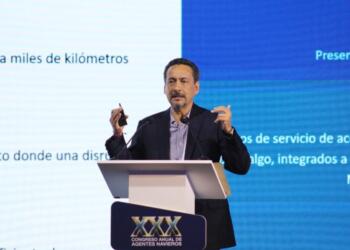
During his participation in the panel “Facilitation of Mexican Foreign Trade”, at the 8th Amacarga Congress , he assured that if greater efficiency is achieved in various customs processes, foreign trade volumes will increase , “which brings benefits to all of us, including tax collection.”
“In order to receive all the information, we need the necessary infrastructure to store and analyze it. In the first six months of this year, priority customs offices must be fully equipped with the necessary infrastructure. Currently, only 7% of our vehicles are automated; we need to invest heavily in infrastructure to streamline everything,” he noted.
He noted that the Mexican Single Window for Foreign Trade (VUCEM) is in place, procedures have been simplified in various agencies, and work is underway to digitize them.
Claudia Franco Arias, director of International Transport Affairs at the Ministry of Infrastructure, Communications and Transport (SICT) , agreed that facilitating and digitizing customs processes increases revenue in a sustainable way .
“Freight forwarders are important players; we will no longer see them as mere logistics facilitators. Now we will see them as more focused and specialized because they consider different elements such as security, economics, and adequate logistical traceability to streamline and manage the costs we are experiencing with tariffs,” he stated.
For his part, José Ignacio Aguado, Director General of Innovation, Services and Domestic Trade at the Ministry of Economy (SE) , indicated that the focus should be on trade facilitation, for which there are the Mexico Plan, development hubs, the relaunch of the “Made in Mexico” brand, among others.
“With the review of the USMCA, we want to accelerate nearshoring , and this is through facilitation, not only with the integration of Mexican government actors such as the SICT, the Treasury, ANAM, and the single window, but also with foreign trade actors such as freight forwarders. Integration is a great step because it gives certainty to the outside world,” he emphasized.
He argued that to make the country more competitive, the public sector needs to be more efficient through technology and innovation.
Comment and follow us on LinkedIn: @Evangelina del Toro / @GrupoT21