The auto parts industry is going through one of its most decisive periods. The renegotiation of the United States-Mexico-Canada Agreement (USMCA), trade tensions with the United States, and nearshoring 2.0 are redefining the conditions under which the sector will operate in the coming years.
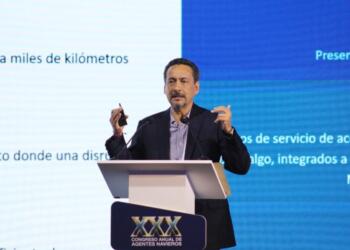
Gabriel Padilla, general director of the National Auto Parts Industry (INA) , highlighted during his participation in the Mexico’s Nearshoring & Logistics Auto Industry Summit that the country has a privileged position in North America, but warned that maintaining that leadership will depend on reducing regulatory uncertainty and strengthening the national supply chain .
Mexico has ceased to be merely an assembly platform and has become a hub for advanced manufacturing. It is currently the leading supplier of auto parts to the United States, and the integration of the regional supply chain has transformed the country into a strategic player for North American competitiveness.
According to the INA, 43% of the auto parts used by US manufacturing come from Mexico , reflecting a deeply integrated supply chain.
“We have more than two thousand auto parts producers in the country, we generate more than 850,000 direct jobs and the value of production is over 119 billion dollars (mdd) annually; we are the most indispensable part of the supply chain, not only in Mexico, but at a regional level,” he said.
The executive emphasized that the review of the USMCA will define the rules of competitiveness in the coming years . In that context, he noted that the sector seeks to preserve free trade for auto parts that comply with the rules of origin and avoid new requirements that increase costs or limit regional integration.
One of the central concepts of his presentation was nearshoring 2.0 , which, he said, no longer consists solely of bringing production closer to consumer markets; it involves redesigning entire supply chains under criteria of resilience, traceability, economic security, sustainability and preferential market access.
He explained that flexible electrification, software -defined vehicles , productive regionalization, resilience and productive sustainability are the trends that are redefining nearshoring 2.0.
For Padilla, competitiveness no longer depends solely on labor costs. Today, companies evaluate factors such as energy availability, logistics infrastructure , water, specialized talent, digitalization, and regulatory certainty before deciding on new investments.
The uncertainty generated by US trade policy continues to delay investment projects, even though production remains positive. In the first quarter of 2026, auto parts manufacturing totaled $31.185 billion , a 9.58% increase compared to the same period in 2025.
Padilla noted that companies have chosen to postpone expansion decisions while the new business environment resulting from the review of the USMCA and the tariff measures promoted by the United States is being defined.
Another challenge identified was strengthening regional content. To achieve this, it was considered essential to develop a larger base of Tier 2 and Tier 3 suppliers, reduce dependence on inputs from Asia, and close gaps in strategic sectors such as semiconductors, automotive electronics, advanced materials, software , and artificial intelligence (AI).
The director of the INA emphasized that the next wave of investment will come seeking engineering, automation, and technological development capabilities. Therefore, Mexico must evolve from a highly efficient manufacturing platform to a technological one capable of designing, validating, and developing components from North America.
The success of the auto parts sector will depend on maintaining clear rules and strengthening regional investment, where the review of the USMCA should become an opportunity to deepen North American production integration and not an obstacle to competitiveness in the region.
Comment and follow us on LinkedIn: @Humberto Cruz Moya / @GrupoT21