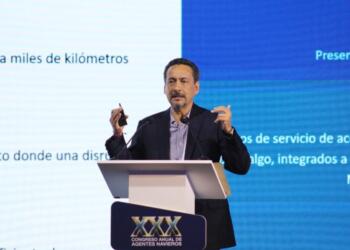
In the logistics industry, historically dominated by men, female participation has become a key driver of transformation , as highlighted by Jonnathan Solís, Business Development Director of Geotab .
In that regard, she emphasized that women’s talent has not only strengthened the company’s internal structure, but has also contributed to redefining how solutions are developed within the telematics and mobility sector .
The company, of Canadian origin and with more than 25 years of experience, has integrated a strong female influence since its beginnings.
“Women are a fundamental part of Geotab’s DNA,” Solís stated.
He recalled that both the founder’s family and current leaders have promoted this vision over time.
Today, this culture is reflected in a high participation of women at management levels , including vice-presidential positions leading key areas of the business in markets such as the United States and Latin America.
Furthermore, Geotab has sought to highlight female talent beyond the corporate environment, and for Solís, the inclusion of women has had a direct impact on innovation.
“Women bring a different perspective that has allowed us to develop solutions that we didn’t see before,” she explained.
This approach has been especially relevant in the development of more operator-centric products and in building more comprehensive ecosystems within the company’s technology platform.
However, she acknowledged that significant challenges remain in achieving greater representation of women in leadership positions within the industry. More than structural barriers, she noted, there are persistent paradigms that need to be broken.
“There is a perception that women are more ‘soft’, but the reality is different; they are extremely strategic, brave, and results-oriented,” she emphasized.
In this context, various initiatives have been implemented to promote diversity and inclusion , including professional development programs, policies of respect and equality, as well as schemes that promote work-life balance, especially for women seeking to combine their professional growth with motherhood.
Looking ahead, Solís believes that progress towards a more equitable industry does not depend on a single actor.
“It is a joint effort between companies, society and government,” he noted.
Their vision is clear: to create an environment where men and women can fully develop, without prejudice, and where talent is the main driver of growth.
“We need more women in leadership positions. They are not only welcome, they are necessary,” she emphasized.
Comment and follow us on LinkedIn: @Jennifer Galindo / @GrupoT21