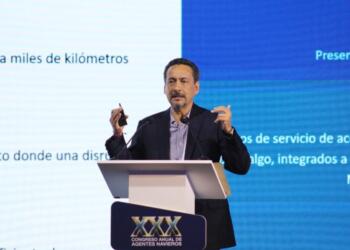
Telemetry is no longer a tool reserved for large corporations. Rising operating costs, a shortage of operators, increased security demands, and the need to optimize every asset have begun to accelerate its adoption among medium-sized companies and even small carriers. In this context, Mexico has become Geotab ‘s main market in Latin America and the starting point for the company’s regional expansion, Juan Cardona, Vice President of Sales for Latin America, told T21 in an interview.
Cardona explained that, while the company initially established its presence in the region by serving large corporations with global operations, the market has evolved to encompass a much broader spectrum. Today, he said, interest also comes from medium-sized companies and small transportation businesses seeking to enhance their competitiveness in the face of increasingly demanding clients.
“It’s more expensive not to have the technology than to have it,” Cardona stated, arguing that a proper implementation can recoup its investment in three to six months thanks to the operational savings achieved. “We’re not really salespeople, we’re consultants,” he added, explaining that Geotab’s model is based on helping companies interpret data and turn it into business decisions.
The executive believes that the growth of outsourced transportation is also changing the profile of telemetry users. Companies that previously operated exclusively with their own fleets are increasingly turning to smaller carriers to meet increased demand, so having platforms compatible with their clients’ technological standards can become a differentiating factor.
One of the aspects that stood out most during the interview was the value of data in identifying inefficiencies that often remain hidden within organizations. Cardona pointed out that, on several occasions, data analysis has revealed administrative errors that for years represented financial losses for companies.
“It’s not me saying it, it’s the technology,” he stated, referring to situations where data reveals poor operational practices or incorrect decisions. He even acknowledged that some organizations initially rejected adopting these tools precisely because they expose these shortcomings, although they later end up using them again when seeking to improve their performance .
From their perspective, the greatest benefit of telematics lies not only in monitoring vehicles, but also in building continuous improvement processes. Companies in sectors such as food and beverage use indicators to compare the performance of their operations with other units within the same group in different countries, setting targets for fuel consumption, road safety, driving, and route efficiency.
The results, he assured, can be directly reflected in operations. Cardona indicated that, at a regional level, Geotab clients have managed to reduce accidents by up to 65% , decrease fuel consumption by around 15%, save between 20 and 22% on maintenance, and increase fleet utilization by 18%.
The adoption process, he explained, begins with the temporary installation of devices on part of the fleet to collect real-time operational data. Based on this weekly analysis, the company identifies atypical fuel consumption, route deviations, aggressive driving, unproductive time, or unauthorized routes—elements that are then used to redesign operations.
“ You can’t manage what you can’t measure ,” Cardona summarized regarding the philosophy guiding this consultative process.
In terms of technology, he noted that the GO device is the core of the platform and can be integrated with solutions such as AI-powered cameras, panic buttons, cold chain systems, trailer tracking, and other specialized devices. Among the practices that generate immediate benefits, he mentioned seatbelt use, reduced idling, route optimization, and leveraging artificial intelligence to design more efficient routes.
It was precisely within this process of technological evolution that Geotab introduced GO Focus Plus , a camera equipped with artificial intelligence that analyzes only critical events, incorporates voice alerts for the driver, and aims to reduce risky behaviors without compromising privacy. According to the company, during pilot tests this solution managed to reduce close following between vehicles by up to 90% and cell phone use while driving by 95%.
The company also recently strengthened its refrigerated transport offering with a new cold chain solution that incorporates IOX-COLD and IOX-COLD Rugged devices , compatible with original refrigeration equipment and designed to reduce merchandise losses, optimize operating costs, and facilitate regulatory compliance.
Cardona emphasized that Geotab’s growth has been supported by the development of its own technology. He explained that both the software and hardware are designed by the company in Canada and that Mexico has a logistics center capable of delivering devices in less than 24 hours. He added that some equipment installed more than two decades ago continues to operate, even in demanding applications such as mining, where data capture and storage must be maintained even without connectivity.
Geotab currently has over six million subscriptions and processes more than 100 billion data points daily. It serves approximately 100,000 customers through a network of 700 business partners and operates in 160 countries with over 3,200 employees. The company is also celebrating its 26th anniversary, supporting its platform with Google Cloud infrastructure and a strategy focused on road safety, operational efficiency, and sustainability.
Comment and follow us on LinkedIn: @GrupoT21