CANCUN, Q. ROO. – One of the constants in the trucking industry is achieving efficiency every day , while also making it safer and more accessible to reduce the challenge of decreasing the shortage of drivers that this activity faces in Mexico and globally.
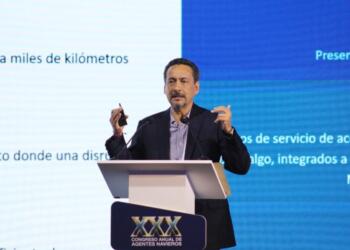
Within the framework of the National Freight Transport Forum , organized by the National Association of Private Transport (ANTP) , representatives of companies of technologies applied to road transport presented the results on the use of these tools in this activity, but also the adaptability that must be had to achieve greater depth in this type of ecosystems .
Luis Campos, global Fleet Director of Grupo Bimbo , raised the need to take advantage of available technology, translating it into efficiency for transport companies.
In that area, Juan Cardona, VP of Sales for Latin America at Geotab , emphasized the mission of technology companies to convert all data into predictive and preventative models.

“Mexico is the perfect storm, with all the drawbacks of high fuel costs, a shortage of drivers, and expensive spare parts. Furthermore, there’s the challenge of always doing more with less,” Cardona stated, and explained how technology now addresses these dilemmas by collecting data and translating it into tangible results, such as a reduction in accidents.
From the perspective of Luis Larrea, Engineering and After-Sales Leader at Samsara , technology should focus on how to help reduce accident rates and improve competitiveness by identifying predictive factors. “Values are what can be acted upon through technology. Telemetry and automation are a means to achieve business objectives . ”
Regarding prevention, José Antonio Alonso, CEO of Freight and Passenger Transport for Numaris , also elaborated, highlighting that close relationships with transport companies are key, stating, “Knowing the Mexican market is fundamental to leveraging the data . “

Meanwhile, Luis Galán, Director of Technology and founder of Tecnomotum , emphasized that technology is just one more element, but the key lies in the people who operate it, and the question that must be addressed is how to use artificial intelligence (AI) to benefit transport companies.
From their perspective, Tecnomotum has focused on identifying the modus operandi of criminals, in order to translate this into system alarms and thus lead to prevention.
One such example is being able to relieve the burden that monitors currently carry with so much data to manage. “The goal is for their decision-making capacity to be focused on elements that make sense to distract them, and therefore, we must focus on how to educate the monitors,” Galán emphasized.

All participants agreed that the use of technology, when employed appropriately, has positive effects on the competitiveness of companies in operational matters, but also on safety results, both in terms of assets and roads.
Comment and follow us on LinkedIn: @Didier Ramírez Torres / @GrupoT21