Mexican logistics is at a crucial juncture. As supply chains evolve toward increasingly digital, automated, and regulatoryly demanding models, the sector faces a challenge that threatens to become one of its major bottlenecks: a shortage of specialized talent .
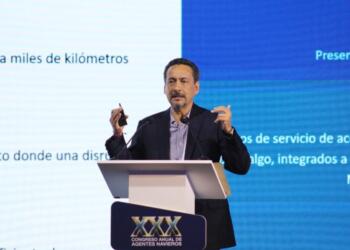
That was one of the central themes of the panel “Efficiency and compliance: The key role of training in the freight forwarder”, held during the 8th Congress of the Mexican Association of Freight Forwarders (Amacarga) , where representatives of the government, business associations and specialists agreed that the professionalization of human capital will be decisive to sustain the logistical and commercial growth of Mexico.
During her presentation, Claudia Alexandra Patrón, Director of Logistics and Supply Chain at the Ministry of Economy (SE) , affirmed that there is a growing interest among younger generations in pursuing professional careers in logistics and foreign trade. As an example, she highlighted that 90% of the 45,000 users of the Ruta Logística platform are under 44 years old.
“The need for training exists, and new generations are looking for places to do it,” he said.
The official explained that the success of these platforms has also been reflected in the demand for recorded content, as some training modules have exceeded 12,000 views on YouTube.
However, he warned that the growth of the logistics sector is putting significant pressure on the availability of skilled talent . According to data shared during the panel, Mexico currently faces a shortage of nearly 30% of trained personnel to meet the sector’s operational needs.
“We can have the best ports, the best warehouses, and the best infrastructure, but someone has to operate all of that. Artificial intelligence cannot make decisions on its own,” he argued.
The logistics director emphasized that this challenge will be even more relevant considering that the logistics sector maintains growth expectations of close to 7% annually.
One of the concepts that took center stage during the panel was micro-credentialization , a training model focused on certifying specific skills through short, flexible courses supported by technologies such as blockchain .
Victor Cruz, vice president of Amacarga, pointed out that this type of tool responds to a global context where constant updating is no longer optional.
“The World Economic Forum determines that 50% of workers will require an update in the next five years to remain relevant,” he commented.
He added that micro-credentials allow for traceability of acquired knowledge and make it easier for people to demonstrate their skills on digital platforms and professional networks.
Francisco Javier Lagunes, president of the National Association of Importers and Exporters of the Mexican Republic (ANIERM) , explained that micro-credentialing does not replace traditional training models, but rather complements the educational and labor ecosystem.
“Micro-credentialing seeks to address the need to train people in the short term and as quickly as possible,” he emphasized.
He explained that the goal is to generate certifications focused on specific skills within broader job functions, allowing workers to be trained in a specific and practical way.
However, both Lagunes and Claudia Patrón agreed that Mexico must take advantage of all available tools to professionalize the sector: diplomas, job skills, certifications, standards and academic training .
“We shouldn’t leave everything aside. We have to use the full range of tools,” Patrón stated.
Another topic that emerged during the conversation was the lack of accurate information on logistics human capital in Mexico.
Claudia Patrón acknowledged that the country still lacks reliable statistics on how many specialized professionals actually exist in logistics and foreign trade, as well as on the specific training needs within the industry.
“We need a lot more statistics in Mexico. There’s a whole universe of real data traceability that’s been lost,” he commented.
He added that this situation also reflects a cultural problem related to the monitoring of studies, censuses and the collection of sectoral information.
Nevertheless, he insisted that the demand for training is already evident and that institutions have a responsibility to respond with useful and accessible tools .
In that regard, he shared a piece of data that he considered especially worrying: only two out of every 10 micro, small, and medium-sized enterprises (MSMEs) have at least one person specialized in logistics.
“Everyone handles logistics, but not everyone has specialized personnel. And that ends up complicating operations,” he explained.
According to him, a large part of the errors, delays or fraud in international operations stem from a lack of knowledge about processes, documentation and regulatory compliance.
Training and labor compliance under the USMCA
The panel also addressed the growing relationship between training, labor compliance, and international trade.
Raúl Martínez Flores, director of Regulations, Support for Social Dialogue and the New Labor Culture of the Ministry of Labor and Social Welfare (STPS) , recalled that, after the entry into force of the Treaty between Mexico, the United States and Canada (USMCA) , Mexico assumed labor commitments linked to rights of freedom of association and collective bargaining, which may lead to trade disputes through the Rapid Response Labor Mechanism.
Currently, he explained, there are 47 cases related to this mechanism, most of them driven from the United States.
“The United States could even tell a company: since you don’t respect those rights, your goods will no longer be allowed in,” he noted.
The official emphasized that many companies may commit violations due to a lack of knowledge, which is why labor training becomes strategic to avoid commercial disputes.
In addition, he highlighted that the STPS maintains free training programs such as PROCADIST and internal instructor training schemes for companies.
Martínez Flores also invited business organizations to become external training agents and develop specialized programs for their industries.
Digitization, collaboration and dignification of the sector
The participants agreed that the future of Mexican logistics will depend on three main factors: digitalization, collaboration, and dignifying the sector.
Claudia Patrón argued that for many years each actor in the chain worked in isolation: customs agents, freight forwarders, importers, exporters, and authorities.
Now, he said, it will be essential to build a joint vision between the private sector, government and academia to develop training solutions aligned with the real needs of the country.
“We need to work together. It’s the only way to generate solutions and provide adequate training,” he stated.
He also highlighted the importance of recognizing the strategic value of logistics within the Mexican economy.
“Logistics doesn’t just move goods, it moves economies and connects nations,” he emphasized.
For his part, Javier Lagunes asserted that Mexico has a historic opportunity to consolidate itself as a logistics hub in North America and as a strategic link with Asia, Europe, and Africa.
However, he cautioned that achieving that goal will depend on the country’s ability to train specialized talent more quickly and efficiently.
“We need competent people to do things better and have greater productivity,” he stressed.
Comment and follow us on LinkedIn: @Jennifer Galindo / @GrupoT21