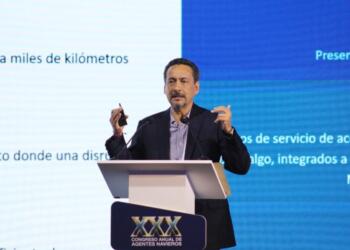
The Mexican Association of Railways (AMF) identified ports and border crossings as the main bottlenecks for the development of the railway industry and trade with North America.
“We have a very clear focus on ports and borders, on how to make them more efficient. Much progress has been made in inland terminals, but if we manage to free up the capacity that is currently tied up in the ports, we can continue improving terminal capacity,” stated Francisco Fabila, president of the AMF.
During the conference “Integrated Railway Systems in the Mexican Railway Association” , organized by the College of Civil Engineers of Mexico (CICM) , he noted that the organization has already held meetings with the National Customs Agency of Mexico (ANAM) to identify and address the main operational obstacles in ports and border crossings.
The goal, he said, is to standardize customs inspection processes between Mexico and the United States through coordination between customs authorities and US Customs and Border Protection (CBP) , with the aim of streamlining rail transit by replicating similar schemes to those already in operation with Canada.
Fabila added that, although incidents of vandalism, blockades and thefts persist , collaboration with the federal government has allowed for strengthening railway security.
“We are experiencing a very good moment in comparative terms with the highway; today there is a pleasant sense of security,” he emphasized.
In that regard, Héctor Lases, coordinator of the CICM’s Transportation Infrastructure Committee, agreed that the modernization of customs is required; in addition, there are challenges in the Waybill and dispatch , as well as blockages, thefts and vandalism, although these have decreased.
“There is also an uneven playing field with the rest of the multimodal transport, excess dimensions, route, training, etc., saturated terminals; we need more and better terminals to encourage the use of rail and not only the last mile is used for the delivery of goods and raw materials that are moved to different consumers and companies,” he specified.
Francisco Fabila stated that in the coming years, the industry will invest with the goal of continuing to increase cargo handling by this mode of transport at border crossings, and developing more cargo at the border that contributes to trade in North America .
In addition to making investments in ports to increase the participation of the railway in these infrastructures, mainly in Manzanillo, as well as developing other terminals.
“Today, with what we have, we have sufficient capacity to meet the challenges, and in recent years many intermodal terminals have opened, yard capacity has increased, and sidings on the main lines are becoming longer; let’s remember that sidings were 800 meters long when the concessions were granted, and now they require them to be more than 3,000 meters long in their expansion to accommodate rail operations. It’s a very coordinated dynamic in terms of maintenance and investment capacity generated by new development; this is something that the railways do every year,” Fabila pointed out.
However, he stated that the evolution of the railway is not about building more tracks , but about how to make the existing ones more efficient.
“Building for the sake of building is difficult. What you have today is what you get. The railway evolved from what we call the milkman’s train, which was ‘I’ll leave a car for you, I’ll leave a car for you, I’ll leave a car for you,’ and it evolved from prioritizing traffic density on long journeys to democratizing it with the intermodal sector,” he said.
Francisco Fabila and other logistics specialists will participate in ETYL MTY , organized by Grupo T21 , which will take place on October 14 and 15 at the Presidente InterContinental Monterrey in Nuevo León . We invite you to learn more about the event and register here .
Comment and follow us on LinkedIn: @Evangelina del Toro / @GrupoT21