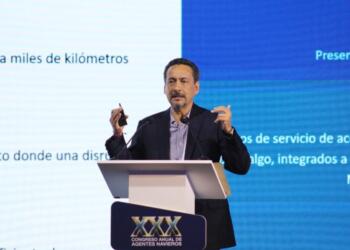
SÃO PAULO, BRA.- The day before, they had shared where they came from, what drove their businesses, and how they got into transportation. This time, the women gathered at Queen On The Road had to look ahead.
The question was no longer who you are, but what kind of leader you will have to be to remain relevant in an industry that is changing before your eyes .
Artificial intelligence (AI) , new generations, reputation, communication, innovation, and the future of work all came up in the conversation. But the more they talked about transformation, the more the discussion returned to something seemingly simple: people


Because while a machine might be able to process more information, automate a task, or deliver an answer in seconds, what remains on the other side are abilities like listening, questioning, connecting, making difficult decisions, and having conversations that are often uncomfortable.
That was one of the threads touched on during the second day of Queen On The Road , Scania ‘s annual meeting which this year celebrates 10 years of bringing together women from the transport and logistics sector in Latin America, with the intention that the conversations transcend the event and multiply within their companies .
The discussion is particularly important in an industry where female participation is still a minority. In Mexico, women held 21.4% of jobs in the transportation sector in 2024, compared to 78.6% for men , according to the National Institute of Statistics and Geography’s (Inegi) Annual Transportation Survey (EAT) .
Sandra Huerta, Chief Marketing Officer of Scania Peru , put forward an initial idea: when we talk about innovation, we almost automatically think of technology. But it doesn’t necessarily have to be that way.
Innovation also means questioning, facing different scenarios, making difficult decisions, and finding ways to remain relevant in a constantly evolving environment. The conversation then shifted to relationships, alliances built throughout a career, intergenerational coexistence, and the future of work.
Too many messages, too little clarity
And then a problem arose that is probably familiar within any company. What to use? WhatsApp, email, internal chats, groups, or face-to-face conversations? Where is the important message? In a world saturated with information, Huerta argued, the leader also has to learn to simplify, to be human .
This doesn’t mean turning our backs on AI. Companies will have to learn how to use it, and employees will need to develop new technical skills. The challenge will be doing both at the same time.
For an industry accustomed to measuring kilometers, tons, delivery times and productivity, there are variables that are much more difficult to put on a table: trust, empathy, clarity, the ability to listen and the courage to hold difficult conversations .
Comment and follow us on LinkedIn: @Karina Quintero / @GrupoT21