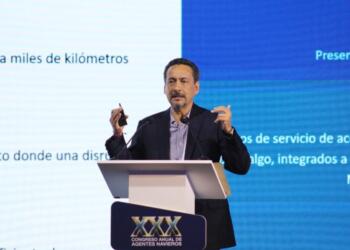
Mexico’s entry into the Asia-Pacific Economic Cooperation (APEC) forum in 1993 marked a new chapter for the country’s logistics, resulting in a port and economic reconfiguration by putting Mexico’s diplomatic and commercial relations with the nations of that region on the map.
The most important shift was not only the formal incorporation, but the fact that Mexico began to steer towards the countries of that economic bloc, which triggered a transformation in the way logistics chains were organized in the Pacific .
“Since we joined the Asia-Pacific framework in 1993, but especially since we turned our attention to Asia-Pacific, there has been a reconfiguration of logistics in the Pacific,” emphasized Sergio Ley, a full member of the APEC Business Advisory Council (ABAC) .
To put this shift into perspective, Ley shared that in the 1990s and early 2000s, the most important entry point for Asian products in Mexico was Ciudad Juárez.
“Which port received the most imports from Asia? I could tell you it was Manzanillo or any Pacific port, but no, the port that received the most goods from Asia was Ciudad Juárez,” the specialist pointed out in an interview with T21.
In the 1990s, Mexican logistics was characterized by a growing demand for services, driven by the then North American Free Trade Agreement (NAFTA) , which came into effect in 1994, and cross-border trade. However, although the logistics infrastructure had improved—especially with road construction—it was still insufficient.
Ley recalled that from a logistical point of view, the ships that came from Asia did not touch any Mexican port or did so sporadically , “so, we had to use the one in Long Beach, mostly, but also other North American ports, in addition to the train.”
With Mexico’s integration into the Asia-Pacific framework and the opening of embassies in the region, a reconfiguration of the entire area’s logistics network was spurred . “Now, we receive a significant number of ships in Mexican ports such as Lázaro Cárdenas, Manzanillo, Mazatlán, and also, to some extent, in Ensenada.”
At the same time, Baja California consolidated its position as a strategic manufacturing hub . In cities like Tijuana and Mexicali, raw materials from Asia were assembled and subsequently exported to the United States and other regions, Ley commented.
Currently, the state has a strong export and manufacturing focus. The maquiladora sector reached record exports in 2025, with 390,972.9 million pesos (MXN) , representing a 14.7% increase compared to 2024, according to figures from the National Institute of Statistics and Geography (INEGI) .
For Sergio Ley, the country’s logistical reconfiguration that began with Mexico’s integration into APEC will continue despite certain frictions in trade with the Asian region, “but I believe that this will be to some extent temporary because it is impossible for us to stop looking towards that side of the world ,” he explained.
It is worth remembering that Mexico implemented a series of diverse actions, such as the General Import and Export Tax Law (LIGIE) , which came into effect in January of this year, to collect tariffs on 1,463 categories of goods and services imported from nations with which the country does not have a trade agreement, including China, India, Thailand, Indonesia and South Korea.
One of the aspects Ley considered for further progress in the logistical integration of Mexico and APEC is that “ the world’s economic center of gravity has already shifted from the Atlantic to the Pacific . There is infinitely more business moving in the Pacific than in the Atlantic at this time,” he emphasized.
The 21 economies of the Asia-Pacific region that make up APEC represent approximately 60% of global GDP and concentrate about 50% of global trade, making it a commercially dynamic bloc.
Thus, the Asia-Pacific logistics reconfiguration is not merely an operational adjustment, but a profound redesign of global trade routes. By repositioning itself along this axis, Mexico is not only redefining its logistics, but also its role in the global economy .
Comment and follow us on LinkedIn: @Humberto Cruz Moya / @GrupoT21