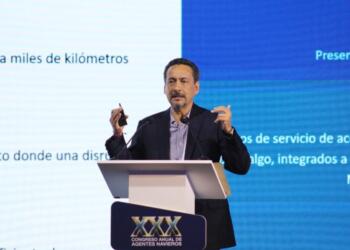
CANCÚN, Q. ROO – Logistics and transportation are facing unprecedented pressure from factors beyond companies’ control, ranging from geopolitical volatility and tariffs to rising fuel costs and increasingly aggressive international competition. In this context, artificial intelligence (AI) has moved beyond being a technological promise to become a tool capable of increasing productivity, reducing costs, and strengthening the competitiveness of supply chains, stated Nabil Malouli, a specialist in global logistics and technological trends, during his participation in the 2026 National Freight Transportation Forum , organized by the National Association of Private Transportation (ANTP) .
The specialist, who worked for nearly two decades at DHL and currently promotes technology adoption for businesses from the independent consulting stage, argued that the main challenge for the industry is not anticipating whether innovations will arrive, but preparing to incorporate them before they become commonplace. “ Any disruptive innovation or transformation goes through three phases : the ideas seem ridiculous; then we try to block them because we think they are dangerous; and finally, they become obvious,” he stated.
As an example, he cited the rapid expansion of autonomous vehicles in U.S. cities, a technology that, he said, still seems distant for Mexico, but whose arrival he considers inevitable. “It’s going to arrive, there’s no doubt about it,” he asserted, noting that the country is already conducting pilot tests and that the technological development will eventually spread to major markets.
Malouli warned that the global environment has become increasingly complex for logistics planning. International conflicts, changes in U.S. trade policy, uncertainty surrounding the United States-Mexico-Canada Agreement (USMCA), and geopolitical tensions create an environment that makes long-term decision-making difficult for companies.
In that context, he explained that while factors such as tariffs or the international price of fuel remain beyond the control of companies, there is room to act on operational efficiency. “None of us can control the price of fuel (…) but what we can control are our costs and the efficiency of our industry,” he emphasized.
The speaker emphasized that Mexico maintains favorable fundamentals for further consolidating its position as a manufacturing and logistics hub thanks to its geographic location, its network of trade agreements, and the sustained growth of international trade. This is further bolstered by an increase in cargo volumes and foreign investment from companies already established in the country.
However, he also drew attention to the advance of Chinese competition, particularly in industries such as automotive and e-commerce. He noted that manufacturers from that country are accelerating their international expansion through investments in strategic markets such as Mexico, Brazil, Chile , and various regions of Europe and Africa, while e-commerce platforms have transformed the competitive dynamics of numerous sectors in just a few years.


The growth of e-commerce represents another major driver of transformation for logistics. Malouli explained that this channel requires redesigning supply chains , modifying inventory locations, rethinking last-mile delivery strategies, and raising service levels to meet increasingly demanding consumers.
“ E-commerce is transforming the supply chain of brands,” he stated, anticipating that the penetration of this model will continue to grow in Mexico over the next few years.
Based on this new environment, he argued that transportation is undergoing a technological transition from traditional vehicles to connected, intelligent, and eventually fully autonomous units. Telemetry, connectivity, management systems, and data analysis are all part of a process that has already begun and will shape the evolution of the sector.
But the central theme of his presentation revolved around artificial intelligence as a lever for improving the profitability of transportation and logistics companies. Unlike other technological investments that were previously only accessible to large corporations, he stated that today any organization can begin developing specific solutions with much more affordable investments.
“AI can be applied in all areas of business,” he explained, listing use cases in operations, customer service, sales, human resources, data analysis, billing, and administrative processes.
To illustrate this, he presented an example of an artificial intelligence agent capable of automatically handling calls from operators reporting roadside incidents, validating information, generating recommendations, and escalating cases when necessary. He explained that this type of tool reduces response times and frees up staff for higher value-added activities.
“If you create efficiencies, you can put those people to work helping the business grow,” he said, rejecting the idea that AI should be understood solely as a job replacement mechanism .
Malouli also insisted that the failure of numerous artificial intelligence projects is not due to limitations of the technology, but rather to a poor definition of the problems they seek to solve. Before selecting a tool, he said, companies should ask themselves why they want to implement it and what strategic objective they are pursuing: defending their business, expanding it, or targeting new markets.
“We often start with technology. But we really need to ask why ,” he pointed out.
He also recommended abandoning the idea that a company needs completely clean databases to start AI projects. In his view, it is enough to organize the information related to the specific use case that is intended to be solved.
“ That’s the biggest lie there is,” he said, referring to the belief that all corporate data must be sorted before starting any project.
Another aspect he highlighted was the advancement of artificial intelligence applied to the physical world through smart cameras, computer vision, and systems capable of automatically identifying vehicles, detecting risky behavior, or activating security protocols. He also noted that the Internet of Things (IoT) will continue to drive fleet connectivity , while the transition to electric vehicles will progress as infrastructure and business models improve.
Finally, he called on the attendees to stop viewing artificial intelligence solely from a theoretical perspective and to start experimenting with it in the daily activities of their organizations.
“Understanding is not enough,” he stated. “Try it ,” he insisted, recommending that every professional use AI tools to analyze reports, summarize information, or automate repetitive tasks.
In his closing remarks, he argued that artificial intelligence will hardly replace workers completely, but it will profoundly change the way they carry out their activities.
“No job can be 100% replaced, but all jobs can at least be increased or replaced by 50%,” he concluded, considering that raising productivity through these tools represents an opportunity that the logistics and transportation industry cannot afford to miss.
Comment and follow us on LinkedIn: @Enrique Duarte Rionda / @GrupoT21