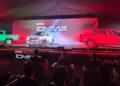
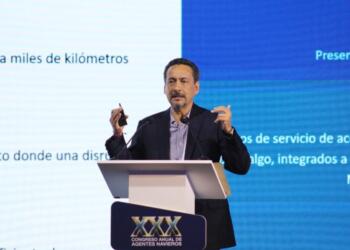
SAN MIGUEL AMEYALCO, STATE OF MEXICO – Over the past five years, the pickup truck segment (Light Commercial Vehicles – LCVs) has been one of the most dynamic in the automotive market. “In the first half of 2026, this segment registered a growth of 16.9% compared to the same period in 2025, in addition to being the second largest in volume in the Mexican market , and we see that it faces increasing competition,” highlighted Guillermo Rosales, executive president of the Mexican Association of Automotive Distributors (AMDA) , during the launch of the Isuzu D-MAX model .
Isuzu has a 100-year history in the automotive industry, 60 of which have been spent in the LCV market, where it has developed six generations of the D-MAX pickup. Now it arrives in the Mexican market with three versions: SE, HL, and DX , described Yoshihiko Watanabe, CEO of Isuzu Motors of Mexico.
Isuzu has had a presence in Mexico for 21 years, and the decision to enter the market was driven by the growth the Mexican market has experienced in this segment. “We are observing interesting growth in this market at a rate of 10 to 15% annually, so we expect greater acceptance of our diesel engine offering,” Hiroshi Ikegawa, president and COO of Isuzu Motors de México, told T21.
With the introduction of the D-MAX, Isuzu is venturing into the recreational or family vehicle sector , which until now had not been present due to its offering of trucks from Class 1 to Class 7.
From Ikegawa’s perspective, D-MAX’s presence is supported by a network of distributors that has been consolidated over 21 years in Mexico, where with 36 dealerships that translate into 43 service points and 40 authorized workshops of the brand , “we can serve at least 83 points in the Mexican Republic, there is no place where we do not have service from the brand.”
While there is no specific sales target for the D-MAX, Isuzu aims to reach 10,000 units in the Mexican market by 2030, with 7,500 trucks from the ELF and Forward families and 2,500 from the D-MAX range contributing, Hiroshi Ikegawa anticipated.
Although the mid-size pickup segment is one of the most competitive, with a presence from various Asian and American brands, Isuzu executives believe that diesel engines are a key differentiator , coupled with a focus on robustness in demanding global markets and extreme temperature conditions.


The D-MAX models that will be sold in the Mexican market are manufactured at Isuzu’s plant in Thailand, a mature market for this type of vehicle. ” The D-MAX models are present in more than 120 countries , feature the 3.0 diesel engine, and will meet the needs of Mexico, which is a very dynamic market,” explained Junichi Kubo, president of Isuzu Motors International Operations Thailand.
From the perspective of Yohei Kato, General Manager LCV Business Department of Isuzu Motors Limited, the presence of D-MAX opens a new chapter in Isuzu’s presence in Mexico, where the growth potential can be addressed.
Dual proposal
The D-MAX pickup enters the Mexican market with three cabs; the first, the SE Single Cab , is configured as a work tool, with 4×2 traction and manual transmission.
During the test drive designed to familiarize ourselves with the models, the ample space in the box was verified to maximize the cargo space of up to one ton, where the diesel engine guarantees proper performance in the demands of work activities.
The HL Double Cab version has manual or automatic configuration and 4×4 traction, so it has a dual purpose of being a work and family vehicle, or can be used for daily use.
The equipment in this version stands out with 17-inch wheels, an eight-inch touchscreen with wireless connectivity, a reversing camera and a rear differential lock, allowing for both on- and off-road applications.
The top-of-the-range version is the DX Double Cab , which features 18-inch aluminum wheels, automatic transmission, and the highest level of equipment, such as the ADAS Safety Suite, which, among other systems, includes Adaptive Cruise Control, Autonomous Emergency Braking, and Blind Spot Monitor.
All models were tested in on-road activities to check stability, performance, maneuverability and in the case of the DX the autonomous emergency braking could be tested, which would have prevented a collision.
Comment and follow us on LinkedIn: @Didier Ramírez Torres / @GrupoT21