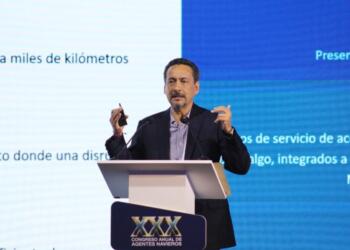
The digital revolution, artificial intelligence (AI), geopolitical conflicts, and nearshoring (relocation of production lines) are redefining international trade and forcing freight forwarders to assume a much more strategic role within global supply chains, warned Thomas Sim, president of the International Federation of Freight Forwarders Associations (FIATA) , at the 8th Congress of the Mexican Association of Freight Forwarders (Amacarga) .
At the conference “The Future of International Trade, the Digital Revolution & Strategic Role of Freight Forwarders”, the executive asserted that the traditional freight forwarder model is outdated and that the sector must transform itself to respond to an increasingly complex, technological and dynamic logistics environment .
“We are no longer just intermediaries. Today we are supply chain managers,” he emphasized.
He explained that freight forwarders currently participate in processes related to multimodal transport, warehousing, insurance, customs compliance, financing, document management and technology, in addition to advising clients on logistics and commercial strategies.
One of the central points of his presentation was the need to strengthen multimodal transport as a response to global disruptions affecting international trade.
The FIATA president mentioned that situations such as tensions in the Middle East, changes in maritime routes and the reconfiguration of trade between China and the United States are forcing companies to rethink logistics corridors and supply strategies.
“Today, multimodality is a fundamental part of value-added services,” he said.
In this context, he highlighted that Mexico faces an important opportunity stemming from nearshoring and changes in global manufacturing and trade flows.
Thomas Sim emphasized that freight forwarders must develop capabilities in areas such as rules of origin, trade agreements, and trade compliance to help their clients optimize operations and reduce tariff costs.
“If a freight forwarder understands trade agreements and rules of origin, they can help modify routes or processes to obtain tariff benefits,” he commented.
He also emphasized the importance of training and professionalization in the sector , noting that many operators continue to work under outdated schemes that no longer meet the current needs of global logistics.
Another highlight was the digital evolution driven by FIATA, particularly through the adoption of electronic documents and technological platforms.
The president of the organization explained that FIATA already has a digital ecosystem that allows the issuance of electronic bills of lading backed by blockchain technology and digital identification systems.
According to Thomas Sim, this model seeks to create a reliable network for freight forwarders, banks, shipping companies and other actors in the logistics chain, reducing fraud risks and improving document efficiency.
He also highlighted that technologies such as artificial intelligence, automation, and digital platforms will continue to transform logistics operations and redefine the role of operators.
The executive invited attendees to the FIATA World Congress, to be held in Milan, Italy, in October 2026, as part of the international organization’s centenary celebrations. FIATA will officially turn 100 on May 31st.
Comment and follow us on LinkedIn: @Jennifer Galindo / @GrupoT21