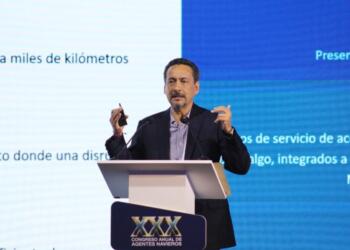
US-based XPO is taking a decisive step in its regional strategy by strengthening its presence in Mexico. The appointment of Jesús Osuna as Managing Director is a move aimed at capitalizing on the potential of the cross-border market and consolidating its operations in both countries.
From Monterrey, Osuna will lead a new stage for the company, focused on getting closer to its customers, strengthening its commercial and operational structure in the country, and driving accelerated growth.
 Although the company has had cross-border operations for decades, until now they were mainly managed from the United States.
“The goal is to bring that footprint we already have in the United States to Mexico, with a local presence, infrastructure and talent that allows us to strengthen the relationship with our clients and grow volume,” he explained.
Mexico, a key player in the regional strategy
For XPO, Mexico is not just an operational extension, but a strategic market. The decision to invest in the country responds both to the demand of its clients , primarily multinationals with operations on both sides of the border, and to the size of the opportunity.
In this regard, the company is considering introducing capabilities in the country, in addition to leveraging its infrastructure in the United States.
“The market share is there. A company like XPO couldn’t stay out of Mexico, especially with the infrastructure, technology, and customers we already have,” Osuna pointed out.
The company’s operational approach is supported by its strength in the United States, where it is one of the main players in LTL (less-than-truckload) cargo , and by its ability to integrate services throughout the entire chain.
Their proposal aims to solve one of the main problems in cross-border transport: the fragmentation of stakeholders. Instead of multiple providers, XPO offers a single point of contact from origin to destination, including tracking, customer service, operational management, and billing.
“We want the customer to have a single point of contact, a single invoice, and a single responsibility. To simplify their life in a process that is normally complex,” he summarized.
This model combines LTL operations with FTL (full truckload) consolidations , leveraging its network in the United States to efficiently distribute cargo once it has crossed the border.
For its operations in the country, XPO has established strategic alliances, notably its collaboration with Almex as its main LTL partner. This partnership will allow it to extend its operating model in Mexico under technological and service standards aligned with its network in the United States.
In parallel, the company is evaluating additional agreements for FTL, with the goal of covering the entire national territory , including regions such as the north and the Bajío.
Unlike other players, XPO does not identify infrastructure or security as its main challenges in Mexico, but rather communication and trust at the operational level.
Osuna explained that, although trade agreements are usually closed in the United States, implementation in Mexican plants faces resistance due to a lack of knowledge about the supplier.
“The challenge is to build trust in the operation. We want the teams on the plant floor to understand our capabilities and overcome any uncertainty about switching suppliers,” he said.
 With a focus on industries such as automotive, high tech , manufacturing and fashion retail , XPO seeks to position itself as the leading cross-border LTL provider between Mexico and the United States.
The goal is clear: accelerated growth and leadership in the segment .
“We didn’t come here just to see how things go. We want to be the best cross-border LTL provider between Mexico and the United States,” Osuna stated.
Furthermore, the strategy is not limited to direct clients. The company also seeks to strengthen its relationship with freight forwarders, whom it considers key allies for expanding its operations on both sides of the border.
Technology and artificial intelligence
One of the pillars of XPO’s strategy in Mexico will be technology. The company is investing in the digitalization of processes through EDI and API integrations , as well as artificial intelligence tools to automate operations, optimize routes, and maximize capacity utilization.
From scanning systems that automatically size the load to platforms that allow real-time visibility and dynamic route allocation, the goal is to eliminate manual processes and improve operational efficiency.
“We want to leave behind Excel spreadsheets and manual reports. Everything is managed by a system, with 24/7 visibility and automated processes,” Osuna emphasized.
Comment and follow us on LinkedIn: @Jennifer Galindo / @GrupoT21