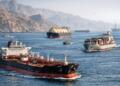
The growing geopolitical tension in the Middle East has once again placed international shipping at the center of a high-risk zone. Recent attacks on vessels transiting the Strait of Hormuz, attributed to Iran’s offensive in the context of its conflict with the US-Israeli axis, have raised alarms in the global maritime community and prompted an urgent statement from the International Maritime Organization (IMO) .
Given this scenario, its Secretary General, Arsenio Domínguez, expressed particular concern about the human impact the escalating conflict is having on commercial shipping. “I am deeply concerned about the safety and well-being of the approximately 20,000 seafarers and 15,000 cruise ship passengers affected in the Persian Gulf, following the recent attacks against international shipping in the Middle East and the Strait of Hormuz,” he warned.
The official stressed that, beyond the implications for global trade—especially on a strategic oil shipping route—the situation poses a direct threat to those operating at sea. “Beyond the economic impact of these alarming attacks, this is a humanitarian issue . No attack against innocent seafarers is ever justified,” he stated.
The Strait of Hormuz is one of the most critical energy corridors on the planet. A substantial portion of the crude oil that supplies global markets passes through this maritime zone, located between Iran and Oman, so any disruption or operational risk has immediate effects on logistics chains and international energy flows.
According to information published by the IMO on significant incidents in the Persian Gulf and Strait of Hormuz region, the conflict in the Middle East has already had direct consequences for the safety of international shipping. Since the start of the military escalation in late February, eight attacks against merchant ships have been recorded, resulting in casualties among the crews, including at least two sailors killed and several wounded, in addition to other incidents involving damage to vessels and situations that have created hazards to navigation.
Documented cases include attacks on ships such as the SKYLIGHT and the MKD VYOM , with crew members injured or killed, confirming that the violence has directly affected the commercial fleet that travels along one of the world’s most strategic energy routes.
In this context, Domínguez reiterated that the IMO remains ready to collaborate with governments, shipowners, and other stakeholders in the maritime industry to protect crews and ensure the continuity of operations. The organization—responsible for establishing global maritime safety and security regulatory frameworks— seeks to contribute to a coordinated response to the growing uncertainty in the region.
At the same time, the Secretary-General made a direct appeal to the shipping industry to strengthen its operational protocols in the area. “I reiterate my appeal to all shipping companies to exercise the utmost caution when operating in the affected region ,” he stated.
The warning comes at a time when several shipping companies are evaluating route diversions, additional security measures , or have even already implemented temporary suspensions of certain transits through the region, in an attempt to reduce the exposure of their crews and assets.
For the head of the IMO, the immediate priority must be to reduce the tension that threatens one of the main hubs of global maritime trade. “I urge all parties to step up their efforts to de-escalate the situation as soon as possible, so that shipping can return to normal,” he concluded.
The development of the conflict and security in the Strait of Hormuz will be crucial for the stability of international maritime transport in the coming weeks, in a context where geopolitics is once again testing the resilience of global logistics chains.
Comment and follow us on LinkedIn: @GrupoT21