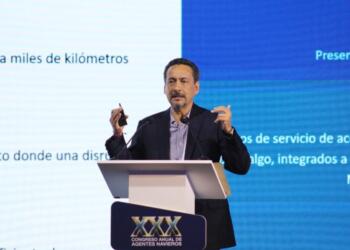
In an industry historically dominated by men, female leadership has moved beyond aspirational discourse to become a strategic driver of competitiveness, innovation, and transformation. Based on this premise, the Chinese shipping company COSCO Shipping Lines brought together representatives from academia, government, maritime associations, and specialized organizations for the forum “Women in the Maritime Sector: Leadership, Contribution, and Future in the Industry.” The forum was held in collaboration with the Institute of Legal Research of the National Autonomous University of Mexico (UNAM) as part of International Women in the Maritime Sector Day, celebrated on May 18th.
Throughout the meeting, the panelists agreed that, despite institutional advances and the growing discourse of inclusion, structural barriers continue to limit female participation in the maritime-port sector , particularly in technical, operational and leadership positions.
“May this forum remind us that the sea does not distinguish genders, but it does recognize talent, preparation, courage, and leadership skills ,” stated Alejandra Álvarez, Administrative Director of Human Resources and Legal Affairs at Cosco Shipping Lines Mexico .
The “glass ceiling” persists at sea
Mónica González, director of the Institute of Legal Research at UNAM, warned that the dynamics of exclusion towards women have evolved and become more sophisticated within industries such as the maritime industry, where institutional discourses of equality often do not necessarily translate into real conditions of access and growth.
“The patriarchal structure is just that, it is a structure, it is a system that is not necessarily noticeable,” she argued.
The academic revisited concepts such as the “glass ceiling” and the “sticky floor,” but proposed a new metaphor to describe the female experience in male-dominated sectors: “the swampy ground ,” where entering and remaining involves constant risks of burnout, exclusion, and professional resignation.
Furthermore, she warned about the resurgence of regressive rhetoric regarding gender equality . “Every revolution has its counter-revolution,” she noted, warning that even hard-won rights are facing new challenges in various political and social spheres.
A strategic industry… with low female participation
The figures presented during the forum highlighted the magnitude of the gender gap that persists in the global maritime sector.
Diana Elena Portilla Romero, executive director of Maritime-Port Strategic Planning at the Ports and Merchant Marine Unit of the Mexican Navy (Semar) , cited the 2024 IMO-WISTA survey, which indicates that women represent approximately 19% of the workforce in national maritime authorities and about 16% in the private maritime sector. For seafarers, the figure is barely around 1%.
María de Jesús Medina Arellano, senior researcher at the Institute of Legal Research, added that the International Maritime Organization (IMO) reported 24,059 women working as crew members in 2021 , an increase of 45.8% compared to 2015; however, they still represent only 1.2% of seafarers worldwide.
“The historical underrepresentation is what has us today making the issue of women visible,” the academic stated.
For her part, Estefanía Leal González, legal director of the Mexican Association of Shipping Agents (Amanac) , noted that more than 80% of Mexico’s international trade moves by sea, making ports key drivers of investment, employment, and competitiveness.
However, female representation continues to be concentrated mainly in administrative and corporate areas, while participation in port operations, technical engineering and cargo handling remains limited.


Digitalization, decarbonization and nearshoring demand new talent
The panelists agreed that the technological and logistical transformation of the maritime sector opens an unprecedented opportunity to incorporate more women into strategic areas.
Estefanía Leal highlighted that the industry is undergoing an accelerated transformation driven by digitalization, automation, artificial intelligence, sustainability, decarbonization, and cybersecurity.
“In this evolution, female leadership is no longer complementary, it is strategic to build a more competitive, modern and inclusive industry,” she stated.
The Amanac representative emphasized that nearshoring represents a historic opportunity for Mexico , triggering investments, port expansion and logistical development, which demands professional profiles with a technological vision and capacity for innovation .
Along the same lines, Diana Portilla emphasized that ports have ceased to be merely points of entry and exit for goods, becoming hubs of connectivity , energy, logistical security, and regional development.
“We need more women participating in technical, regulatory, and strategic decisions. We need more women researching, operating, innovating, and leading,” she said.
The invisible barriers continue to operate
Beyond the statistics, one of the most recurring themes of the forum was the persistence of structural and cultural obstacles that continue to condition women’s professional development.
The participants spoke of discrimination, less access to management positions , unequal wages, workplace harassment, limitations on growth, and disproportionate burdens of family care.
“Sometimes women arrive in these spaces facing additional barriers: lack of representation, stereotypes, limitations on growth, and even the constant need to prove the capabilities they already possess,” Diana Portilla noted.
María de Jesús Medina warned that many women’s career paths take longer to be recognized due to interruptions associated with caregiving responsibilities and the constant demand to demonstrate “double” capabilities.
“Women continue to face discrimination, less access to leadership positions , lack of mentorship, hostile work environments, harassment, and limitations on professional growth,” added Estefanía Leal.
Maritime design also excludes
One of the most unique proposals of the forum came from Aguivar Olidel A. Vite Flores, director for Mexico of the Pan American Institute of Naval Engineering Americas and president of WISTA Mexico , of the WISTA International network , who showed how even the technical design of the vessels continues to respond to masculine parameters.
“There’s no ergonomics on the boats ,” she stated. “The captain doesn’t have a special chair; it’s a chair designed for a man.”
The specialist maintained that naval engineering and maritime design with a gender perspective will be one of the next fields of work within the Veracruzana University.
He also questioned why many inclusion policies remain more in the realm of discourse than in concrete results.
“ Structural barriers continue to hinder an integration that so far has been more rhetoric than effective,” he argued.
She also criticized the fact that in some institutions the female presence continues to be used as a decorative symbol rather than as a true professional recognition.
“Including women as a gesture, that’s what I’m seeing in many organizations,” she said.
Mexico, “with its back to the sea”
Another recurring concern was the lack of maritime culture in Mexico and the limited visibility of the sector among new generations.
“Mexico lives with its back to the sea,” Vite Flores stated, questioning the limited promotion of maritime and naval careers in the country.
The academic explained that, together with colleagues from the University of Veracruz , she promoted a maritime culture and education project since 2014 that finally managed to incorporate maritime content into national textbooks in 2025.
“We are a maritime country. The sea awaits us , let us act,” he said.
Specific legislation for the sector is lacking
Another point of consensus at the forum was the need to move towards regulatory frameworks and specific public policies for the maritime sector.
María de Jesús Medina pointed out that, although Mexico has general laws on equality and non-discrimination, there is still no specialized legislation to address the particular problems of women in the maritime industry.
The researcher noted that international instruments such as CEDAW (Convention on the Elimination of All Forms of Discrimination Against Women), the International Labour Organization (ILO) and various IMO resolutions already include guidelines related to equality, working conditions and safety for women in the sector.
Networks, mentoring and new generations
The panelists agreed that support, mentoring, and professional networks will be key to accelerating the incorporation of women into the sector.
The IMO’s global strategy for 2024-2029 is based precisely on three pillars: training, visibility and recognition .
In addition, the role of organizations such as WISTA International and WISTA Mexico was highlighted , as well as regional WIMAS networks present in more than 152 countries.
“Today, factors such as education, mentoring , and networking are fundamental to expanding women’s access to training, maritime technology, and decision-making spaces,” said Estefanía Leal.
Vite Flores called for abandoning the “imposter syndrome” and understanding that female visibility also implies becoming a role model for other generations.
“We are all important, we are all valuable, and all people have the same value, men and women,” she said.
At the close of the forum, it became clear that the challenge for the Mexican maritime industry is no longer simply about creating opportunities, but about transforming the structures that have historically limited women’s access to operations, decision-making, and leadership. In a sector pressured by digitalization, decarbonization, and global logistics reconfiguration, the panelists agreed that the future competitiveness of the maritime-port system will also depend on its ability to incorporate more female talent at all levels of the supply chain.
Comment and follow us on LinkedIn: @Enrique Duarte Rionda / @GrupoT21