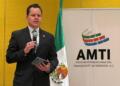
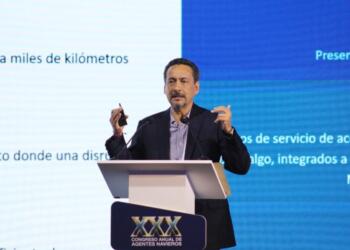
LOS CABOS, BCS – Intermodal transportation in Mexico is experiencing “the best moment in its history.” This was the assertion of Luis Hernández, president of the Mexican Intermodal Transportation Association (AMTI) , at the inauguration of the XXVII Intermodal Congress , where he outlined a landscape of expansion for the industry, marked by record figures , new cargo dynamics, and a growing participation of the sector in the country’s economic and logistical agenda.
Far from presenting a discourse focused solely on statistics, Hernández opted for a narrative that sought to define the current state of Mexican intermodal transport as a result of years of investment, coordination, and integration among operators, terminals, railways, and freight users.
“Today, intermodal transport in Mexico is not only growing, it is experiencing the best moment in its history, and this is not just a figure of speech. The real data tells us this ,” he stated to industry representatives.
The leader explained that during the first quarter of 2026, the intermodal system moved more than 333,000 loaded containers , a figure that represented a 10% annual growth and the best start for the sector in at least seven years. However, he emphasized that the main change lies not only in the volume, but also in the diversification of growth.
“For the first time, success is not in a single sector. Growth was widespread . The cross-border, domestic, and maritime markets all grew together simultaneously, as a single sector,” he stated.
Within that performance, Hernández particularly highlighted the dynamism of the cross-border segment , which registered a growth of 15% and reached a historic record driven by the increase in rail imports from the United States, especially non-automotive cargo.
“We are finally moving away from our dependence on automotive freight as an intermodal industry. We are transforming into a general freight industry,” he said.
According to the president of AMTI, this transition represents one of the most relevant structural changes for the industry in recent decades, because it strengthens the integration of intermodal transport with the consumer, manufacturing and food sectors , expanding the range of goods that use rail and containers as a logistics axis.
This transformation is also reflected in the domestic market, historically considered one of the most complex segments for Mexican intermodal transport . Hernández acknowledged that for years the operating balance of domestic services was negative, although he asserted that signs of maturity are now beginning to appear in key corridors.
“April reflected a 99% balance. In the 17 years I’ve been monitoring this, we’ve never seen a 99% balance. That is, for every load we add, we lose one load,” he commented.
He added that the growth of the domestic market is also being driven by greater confidence among Mexican companies in rail and intermodal services for the movement of consumer goods.
“We went from moving eight thousand containers in 2019 to more than 21 thousand in the first quarter. That’s a growth of more than 150 percent . It’s proof that rail and intermodal transport are now part of the daily life of Mexican companies,” he said.
At the same time, maritime corridors maintained a positive trend, exceeding 210,000 units moved between the country’s four main seaports, with a growth of 7%, in a context where port-rail connectivity is beginning to consolidate as a strategic component for national logistics competitiveness.
However, Hernández insisted that behind the figures there is a network of investments, infrastructure and human capital that has allowed the sector’s growth to be sustained.
“More has been invested in terminals and intermodal corridors in the last 24 months than in the last 10 years,” he said.
In that regard, he acknowledged the work of railway operators, terminal staff and workers in the sector who, he said, keep “the country awake and connected” , while stressing that intermodal transport has ceased to be merely a logistical alternative and has become “the economic engine of the country”.
The president of AMTI also highlighted the strengthening of institutional dialogue between industry and the federal government, particularly on issues related to competitiveness, foreign trade, infrastructure and railway safety .
“We have brought this pride and this technical strength to the most important dialogue tables with the government, with the Ministry of Economy and with Customs ,” he commented.
Within those conversations, he highlighted the participation of the National Service for Agrifood Health, Safety and Quality (Senasica) in promoting corridors for refrigerated cargo, especially from projects led by Canadian Pacific Kansas City (CPKC) to move refrigerated imports by rail.
Hernández also revived the debate surrounding nearshoring – which he preferred to call “nearsource” – and asserted that Mexico is going through a historic juncture resulting from the global reconfiguration of supply chains.
“Now we are truly living the Mexican moment ,” he affirmed. “Geography is on our side, the free trade agreement (USMCA) is here to stay, and we need to understand how we will operate within this new free trade agreement.”
From that perspective, the leader called on the industry to maintain unity and accelerate efforts to build a more efficient, sustainable and secure logistics network , capable of responding to the new demands of foreign trade.
“The real challenge I propose to you today is not to surpass a certain figure next quarter; the challenge is for us to continue walking together, to continue believing in innovation, in leaving a more sustainable world for those who come after us,” he concluded.
Comment and follow us on LinkedIn: @Enrique Duarte Rionda / @GrupoT21