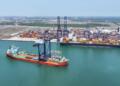
In a logistics environment marked by volatility, adjustments in global supply chains, and capacity pressures on the Mexican Pacific coast, Hutchison Ports LCT closed 2025 with a figure that carries more weight for its context than its sheer volume: 1.5 million twenty-foot equivalent units (TEUs) handled for the second consecutive year at the port of Lázaro Cárdenas. This is not just an operational record, but a sign of consistency at one of the most strategic hubs for the country’s foreign trade.
The milestone was symbolically reached with the arrival of the CMA CGM Cedrus vessel in the final days of the year, a snapshot that encapsulates the terminal’s commitment to maintaining stable flows in a market subject to adjustments in routes, tariffs, and geopolitical decisions. “Reaching 1.5 million TEUs for the second consecutive year represents not just a number, but the consolidation of a terminal that is committed to efficiency, reliability, and sustained growth ,” stated Alfredo Huesca Sánchez, General Manager of LCT, in a press release.
The consistent volume becomes significant when considering the port’s performance. According to the National Port System Administration (Asipona) Lázaro Cárdenas , the port is projected to handle 2.6 million TEUs by 2025 , representing a 10% annual growth rate, solidifying its position as one of the country’s key logistics hubs. Hutchison Ports LCT accounts for the majority of this total, reinforcing its role as a crucial connectivity platform on Mexico’s Pacific coast.
The result is directly related to the terminal’s physical expansion. During the year, Phase III of its growth project progressed, adding 28 hectares and 345 meters of wharf. With this, LCT will reach 1,278 meters of berthing space and a total area of 104 hectares , a scale designed to handle larger volumes with high operational standards. “We will continue innovating, investing, and raising our operational standards to support our clients’ growth and strengthen the port’s competitiveness on high-volume trade routes,” Huesca Sánchez emphasized.
Alongside the expansion, the terminal maintains its alignment with Hutchison Ports Mexico’s Net Zero environmental strategy, led by Jorge Magno Lecona, which aims to reduce absolute greenhouse gas emissions by 54.6% by 2033 and achieve net-zero emissions by 2050. In a port that could also exceed 33 million tons of total cargo this year, the challenge is not only to move more, but to do it better.
Comment and follow us on X: @GrupoT21