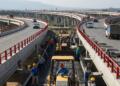
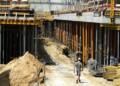
During the construction of the Mexico-Querétaro and AIFA-Pachuca trains alone, 14,500 interferences have been recorded , including limited rights of way and encroachment by populations, which is why agreements and a new regulatory framework for carrying out these projects are being hampered.
General Gustavo Ricardo Vallejo Suárez, commander of the Felipe Ángeles Engineering Group , explained that other interferences include level crossings, pedestrian crossings, medium and high voltage transmission lines, gas lines, pipelines, cross drainage works, and water .
“We’re working in very complicated environments on rights-of-way that are already limited and also encroached upon. These are small rights-of-way, where residential gates have already encroached upon the right. What do we have to do? We can’t build the type of embankment structure we’re familiar with with the natural boundary. We have to build channels and formwork, and we have to go uphill with concrete walls to allow entry to the premises, and that poses additional challenges,” he emphasized.
During his participation in the 22nd edition of ExpoRail , organized by the Mexican Association of Railways (AMF) , he indicated that in light of this scenario, together with the Railway Transport Regulatory Agency (ARTF) , he is working on new agreements and a new regulatory framework with safety factors and high technology, in order to achieve more effective coexistence for passenger and freight trains, as well as for those who live near the tracks.

Similarly, he mentioned that another challenge is environmental , since they will not fragment ecosystems through coexistence, mitigation, compensation, and other work.
“One thing we learned with the Mayan Train is to build without destroying. Wherever we go, we find remains, and what we must do is prospect, inspect, cover, and review them, and if they’re important, even change the route,” he explained.
Vallejo said they expect to encounter other challenges during the construction of these projects , since the road is saturated with residential and industrial areas, which have laredos or railroad spurs.
“What we’re doing is moving the passenger train to one side and then returning it across viaducts, and all of this is costing resources, but it’s to respect the operational efficiency of freight operators,” he emphasized.
Comment and follow us on X: @evandeltoro / @GrupoT21