Banner MSC Banner MSC Banner MSC
ADVERTISEMENT

DON'T MISS OUR PREMIUM CONTENT

SUBSCRIBE
LOGIN
T21
  • Login
  • Register
  • Aerial
  • Automotive
  • Land
  • Railway
  • Maritime
  • Logistics
  • Economy
  • Technology
  • Opinion
  • Magazine
  • ESG
No Result
View All Result
  • Aerial
  • Automotive
  • Land
  • Railway
  • Maritime
  • Logistics
  • Economy
  • Technology
  • Opinion
  • Magazine
  • ESG
No Result
View All Result
T21
No Result
View All Result
• ETYL CALI-BAJA 2026
ETYL
CALI-BAJA

El punto de encuentro de los líderes logísticos de Cali-Baja

Paneles Logísticos + Sesiones de Conexión

Conecte con quienes mueven la logística binacional.

14 de mayo de 2026 Real Inn Tijuana
00DÍAS
00HORAS
00MIN
00SEG
Registrarme Ver programa WhatsApp
• ETYL CALI-BAJA 2026
ETYL
CALI-BAJA

El punto de encuentro de los líderes logísticos de Cali-Baja

Paneles Logísticos + Sesiones de Conexión

Conecte con quienes mueven la logística binacional.

14 de mayo de 2026 Real Inn Tijuana
00DÍAS
00HORAS
00MIN
00SEG
Registrarme Ver programa WhatsApp
Home ESG

Water, energy transition and electromobility: the challenges that will shape Mexico’s sustainable future

The goal is to build more efficient, resilient, and sustainable cities.

T21 Media by T21 Media
21 May, 2026
5
SHARES
ShareShareShare

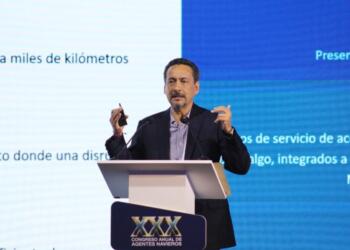
The water crisis, the energy transition, and electromobility cannot be analyzed separately. This was the argument put forward by Yolanda Villegas, CEO of Oleum and president of the Mexican Association of Storage, Electrification, and Mobility (AMAEM) , during the webinar “Water, Energy Transition, and Electromobility ,” organized by the Secretariat of Economic Development of Tamaulipas.

In her presentation, the specialist warned that water has become one of the main global risks to human survival and argued that Mexico faces increasing pressure stemming from climate change, industrial expansion, and the rise in energy demand.

Banner

“Instead of calling ourselves planet Earth, we should call ourselves planet water,” he said.

Villegas González emphasized that the water problem is not only due to the physical scarcity caused by reduced rainfall, but also to an “economic scarcity” related to the lack of infrastructure to bring water to different communities.

In this context, he explained that Mexico faces an unequal distribution of the resource: while the north and center of the country concentrate the greatest industrial and economic activity, much of the available water is located in the south.

He pointed out that the country requires comprehensive water management that considers not only the extraction of the resource, but also its environmental, social and economic impacts.

He also raised the need to explore new technologies for water supply, such as the so-called “ultra-deep underground mega-basins” , a model that seeks to take advantage of water reserves located between three thousand and five thousand meters deep.

According to the speaker, these types of solutions could represent less invasive alternatives than large dams or desalination plants, as they require less infrastructure, less development time, and less environmental impact.

The energy transition is no longer optional.

Villegas warned that the increase in global energy demand continues to drive the use of fossil fuels and, with it, the increase in polluting emissions and global temperature.

Banner

He explained that the energy sector currently generates more than 73% of global greenhouse gas (GHG) emissions , so he considered it urgent to accelerate the shift towards clean energy.

During the webinar , he defined the energy transition as the gradual process by which economies migrate from a matrix based on fossil fuels to one based on renewable energies, electrification and clean technologies.

Among the pillars of this transition he mentioned decarbonization, energy decentralization, digitalization and democratization of access to energy.

The specialist highlighted that Mexico has strategic advantages for this transformation thanks to its solar, wind and hydroelectric potential, particularly in states like Tamaulipas .

However, he also defended the use of fossil fuels and nuclear energy as part of an orderly transition strategy.

“There are countries that continue to use oil, coal, and gas while urging emerging economies to stop. Mexico must take advantage of its energy resources while developing new technologies,” he argued.

Electromobility

Another key topic was electromobility, which, according to Villegas González, will transform the transport industry in the coming decades.

He noted that by 2030, up to 50% of the world’s vehicles could be fully or partially electric , while by 2040 more than 500 million electric vehicles would be on the road globally.

In the case of Mexico, he highlighted the growth of the electric automotive industry and the country’s potential as a producer of auto parts.

“Electromobility doesn’t just mean buying electric vehicles; it requires charging infrastructure, regulation, tax incentives, training, and smarter electrical grids,” he explained.

He also highlighted the progress of cities like Mexico City in incorporating electric buses into public transport, although he acknowledged that there are still significant regulatory and infrastructure challenges.

Among them, he mentioned the lack of public charging stations , the absence of regulation for the final disposal of batteries, the need for safety protocols for fires in electric vehicles, insufficient tax incentives and poor legislative coordination.

The expert insisted that the energy transition will depend largely on political will and the ability of governments to promote clear public policies.

“Public policy is fundamental. Without it there will be no regulation, incentives, or implementation,” he stated.

He also stressed that the State must maintain a leading role in energy, environmental and water issues to guarantee energy security, food security and access to water.

Villegas González argued that sustainable mobility begins with a cultural shift and a change in transportation habits, prioritizing efficient public systems, sustainable infrastructure, and less polluting technologies.

“The goal is not only to electrify vehicles, but to build more efficient, resilient and sustainable cities ,” he stressed.

Comment and follow us on LinkedIn:  @Jennifer Galindo  /  @GrupoT21
Tags: AMAEMCLIMATE CHANGEElectromobilityENERGY DEMANDENERGY TRANSITIONWATER CRISISWATER MANAGMENT

Related news

Greener mobility in Mexico requires greater coordination and a comprehensive strategy

Greener mobility in Mexico requires greater coordination and a comprehensive strategy

14 April, 2026
Infrastructure and planning, challenges for the electrification of passenger transport in Mexico

Infrastructure and planning, challenges for the electrification of passenger transport in Mexico

9 March, 2026
VEMO announces investment in Monterrey to boost electromobility

VEMO announces investment in Monterrey to boost electromobility

5 March, 2026
Charging infrastructure and accessibility would boost electromobility in Mexico

Charging infrastructure and accessibility would boost electromobility in Mexico

4 March, 2026
Next Post
Walmart de México is robotizing its Megapark in Tepotzotlán

Walmart de México is robotizing its Megapark in Tepotzotlán

Supply chains face challenges in the face of nearshoring and the USMCA

Supply chains face challenges in the face of nearshoring and the USMCA

Most Read

  • Mexico and the US make progress in talks on the USMCA; review could be extended

    Mexico and the US make progress in talks on the USMCA; review could be extended

    5 shares
    Share 2 Tweet 1
  • Dongfeng accelerates expansion in northern Mexico with new dealerships in Coahuila

    5 shares
    Share 2 Tweet 1
  • Mexico seeks to streamline foreign trade through digitization and facilitation

    5 shares
    Share 2 Tweet 1
  • Light vehicle sales in Mexico are headed for the fast track in April

    5 shares
    Share 2 Tweet 1
  • Mercado Libre is Strategically Expanding in the United States.

    5 shares
    Share 2 Tweet 1
  • Frialsa reaches 30 distribution centers and strengthens cold chain capacity in Querétaro

    5 shares
    Share 2 Tweet 1

Web Stories

Ver todas
índice de Confianza del Transporte y Logística – Cuarto trimestre 2023
10 destinos de exportación de vehículos pesados 2023
Descubre el Top 10 de destinos de exportación de vehículos pesados en México en 2023
La venta de vehículos pesados rompe récord en 2023
5 marcas de camiones más vendidas
ADVERTISEMENT

Categories

  • Aerial
  • Automotive
  • Land
  • Railway
  • Maritime
  • Logistics
  • Economy
  • Technology
  • Opinion
  • Magazine

Other Links

Contact Us
Advertising contact
Media Kit
Privacy Policy
Cookies policy
  • Contact Us
  • Privacy Policy
  • Cookies policy (EU)

© 2024 T21-US - All rights reserved.

Welcome Back!

Sign In with Facebook
Sign In with Google
Sign In with Linked In
OR

Login to your account below

Forgotten Password? Sign Up

Create New Account!

Sign Up with Facebook
Sign Up with Google
Sign Up with Linked In
OR

Fill the forms below to register

All fields are required. Log In

Retrieve your password

Please enter your username or email address to reset your password.

Log In
Manage cookie consent
To offer the best experiences, we use technologies such as cookies to store and/or access device information. Consent to these technologies will allow us to process data such as browsing behavior or unique IDs on this site. Failure to consent, or withdrawal of consent, may adversely affect certain features and functions.
Funcional Always active
El almacenamiento o acceso técnico es estrictamente necesario para el propósito legítimo de permitir el uso de un servicio específico explícitamente solicitado por el abonado o usuario, o con el único propósito de llevar a cabo la transmisión de una comunicación a través de una red de comunicaciones electrónicas.
Preferences
The technical storage or access is necessary for the legitimate purpose of storing preferences that are not requested by the subscriber or user.
Estadísticas
El almacenamiento o acceso técnico que es utilizado exclusivamente con fines estadísticos. The technical storage or access that is used exclusively for anonymous statistical purposes. Without a subpoena, voluntary compliance on the part of your Internet Service Provider, or additional records from a third party, information stored or retrieved for this purpose alone cannot usually be used to identify you.
Marketing
El almacenamiento o acceso técnico es necesario para crear perfiles de usuario para enviar publicidad, o para rastrear al usuario en una web o en varias web con fines de marketing similares.
  • Manage options
  • Manage services
  • Manage {vendor_count} vendors
  • Read more about these purposes
Ver preferencias
  • {title}
  • {title}
  • {title}
No Result
View All Result
  • Aerial
  • Automotive
  • Land
  • Railway
  • Maritime
  • Logistics
  • Economy
  • Technology
  • Opinión
  • Magazine
  • ESG

© 2023 T21. Todos los derechos reservados

Are you sure want to unlock this post?
Unlock left : 0
Are you sure want to cancel subscription?
índice de Confianza del Transporte y Logística – Cuarto trimestre 2023 10 destinos de exportación de vehículos pesados 2023 Descubre el Top 10 de destinos de exportación de vehículos pesados en México en 2023 La venta de vehículos pesados rompe récord en 2023 5 marcas de camiones más vendidas