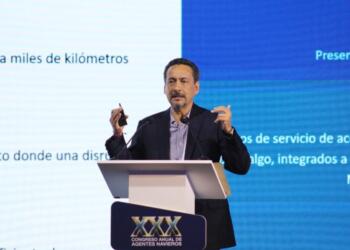
The freight transport sector on Mexico’s northern border faces increasing pressure to sustain its operations, in a context where costs continue to rise, volumes are not recovering, and rates remain suppressed.
In Nuevo Laredo, Tamaulipas, this scenario takes on greater relevance: through this area approximately 42% of the country’s land trade moves , making it a key point to measure the behavior of the sector, according to Pedro Lozano, president of the Nuevo Laredo Freight Carriers Association (ATC) .
In that city , this operational weight is also reflected in the border crossings. In 2025 alone, this point registered 2.28 million truck crossings into the United States , maintaining its position as the country’s main land port in terms of volume, according to the General Directorate of Federal Motor Transport (DGAF) .
In this sense, the profitability of the operation has been pressured by factors such as the increase in fuel, the rise in labor costs and an exchange rate that reduces income in pesos for operations agreed in dollars, as Lozano explained in an interview with T21.
Added to this is the impact of tariffs, which reduced cargo volumes and intensified competition between companies, creating a market where rates have not been able to adjust at the same pace, he warned.
The sector’s main immediate challenge is to regain profitability . Over the past few months, carriers absorbed these increases without fully passing them on to their customers, which is now resulting in a loss of liquidity, Lozano pointed out.

Although volumes are beginning to show signs of recovery, the next step will be to renegotiate rates in an environment where customers are still pushing prices down, he anticipated.
Despite trade uncertainty , regional integration remains strong. The United States-Mexico-Canada Agreement (USMCA) will continue to be the foundation of trade, given that much of Mexico’s production is linked to U.S. companies, Lozano explained.
In that context, the continuity of the treaty is seen as a factor of stability for the flow of goods.
Operation, infrastructure and reviews
At the same time, the operation faces structural challenges . Some sections of highway are beginning to become congested, while toll booths and toll systems are showing deficiencies that affect traffic efficiency, he emphasized.
Added to this are the times spent at checkpoints , where vehicles can remain for up to eight hours, which directly impacts productivity. The sector’s proposal aims to migrate towards more streamlined inspections using non-intrusive technology, Lozano explained.
Security: Pressure from the North
Although northern Mexico maintains relatively stable conditions, the rest of the country presents a different scenario.
In other regions , the theft of vehicles and operational restrictions have forced changes to routes, schedules, and even logistical costs, Lozano said.
In this environment, the pressure is not only on costs, but also on the actual ability to pass them on to the market. The combination of lower production volume and increased competition has created a dynamic in which customers keep prices down, arguing that there is always someone willing to offer a lower price.
“It’s a price war and many don’t realize the costs,” the specialist warned.
The impact is significant. Due to the exchange rate alone, companies have seen reductions of nearly 20% in their revenue in pesos , while the increase in the integrated daily wage has raised social costs, Lozano explained.
Added to this is the impact of fuel . According to industry calculations, for every peso increase in diesel, fares should have been adjusted by around 4%; however, most carriers only managed to achieve partial increases.
“We should have raised our prices by 20%; I assure you that 80% of the transporters did not raise them by that amount,” he said.
The result is direct pressure on liquidity. The trucking industry requires immediate payments, while revenues don’t always keep pace.
“We can’t do free freight, our equipment is valuable and our operation is valuable,” he emphasized.
Meanwhile, the sector is beginning to see signs of recovery in demand. Customs indicators show gradual increases in cargo volumes, which could open the door to a new phase of tariff negotiations, he explained.
However, this process will not be easy. Renegotiating with clients is anticipated to be one of the biggest points of contention in the short term, in an environment where carriers will be looking to recover some of their lost profit margin.
On the country’s northern border, where the movement of goods never stops, the adjustment will not be immediate or uniform. The recovery in volume is only just beginning to emerge, but this doesn’t necessarily translate into better conditions for carriers.
The challenge now is not just to move more cargo, but to make each trip profitable again in a market that has become accustomed to operating with pressured rates.
“Now we have to renegotiate rates,” Lozano summarized.
Because at the country’s main crossroads, where the pulse of foreign trade is measured, the balance of road transport depends not only on the flow of goods, but also on the sector’s ability to sustain its operation in an increasingly demanding environment.
Comment and follow us on LinkedIn: @Karina Quintero / @GrupoT21