



The New Manzanillo Port project , conceived as one of the main bets for the expansion of Mexico’s maritime infrastructure, passed a new administrative stage after the Ministry of Environment and Natural Resources (Semarnat) conditionally authorized its first phase of development in basin II of the Cuyutlán Lagoon , in Colima, a decision that modifies the outlook of an initiative that had only seen its previous environmental assessment procedure concluded in December 2025.
Through the letter SRA/DGIRA/DG-07904-26, dated September 30, 2026 – and made public last week – the General Directorate of Environmental Impact and Risk (DGIRA) resolved the new procedure identified with the code 06CL2026H0009, promoted by the Administration of the National Port System (Asipona) Manzanillo , whose Environmental Impact Statement in regional modality (MIA-R) was prepared by the University of Colima , with the collaboration of the National Autonomous University of Mexico (UNAM) .
The resolution represents progress for the project spearheaded by Mayor Claudia Sheinbaum’s administration, although it does not constitute full authorization to carry out all the planned works . Semarnat (the Ministry of Environment and Natural Resources) determined the conditional environmental viability of the first phase, while the second phase must undergo a new evaluation before construction can begin.
According to the MIA-R executive summary, the estimated investment for the development amounts to 118,391.79 million pesos , financed through federal funds managed by Asipona Manzanillo. This figure corresponds to the project presented by the proponent and not necessarily to the amount of budgetary resources already allocated.
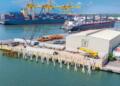
The proposed infrastructure will be distributed in two major phases. The first phase includes the construction of platforms for two specialized container terminals (TECs) , as well as navigation channels, maneuvering basins, roads, railway lines, administrative buildings, port security facilities, and complementary services.
The second plan considers platforms for two other specialized container terminals and a multi-purpose terminal (MPT) , in addition to the expansion of rail and road infrastructure, as well as the deepening of navigation channels.
The executive summary states that the first stage of construction was projected to begin in January 2027, with a duration of six years, while the second stage is planned to begin in January 2049. These periods correspond to the schedule presented in the MIA-R and are subject to compliance with applicable authorizations and conditions.
One of the central components will be the maritime infrastructure. For the first stage, 372.35 hectares are planned for navigation channels and basins , with depths of up to 18 meters in the inner channel, the northern channel, and turning basins 2 and 3. The southern channel will initially have a depth of 10 meters and will be reserved for vessels of the Mexican Navy.
In a second stage, the proposal contemplates deepening the canals and docks to 21 meters , a configuration aimed at serving larger vessels and strengthening the operational capacity of the new facility.
Land connectivity is also part of the planning. The project incorporates external roads to connect the future terminals to the mainland, rail infrastructure, and a parking area with capacity for at least 640 tractor-trailer trucks —elements that aim to integrate the movement of goods with the country’s logistics corridors.
In terms of rail infrastructure , the first phase includes 14.31 hectares for tracks, of which 9.18 hectares will be for an elevated viaduct. The second phase projects an additional 36.03 hectares, including eight tracks of 4.12 kilometers each and an additional two-track section of 850 meters.
However, the environmental authorization of basic infrastructure works does not equate to the automatic approval of future port terminals, whose developers must process the authorizations corresponding to their facilities and activities.
The mangrove, back in the center
The new environmental resolution is especially relevant because the previous project, identified with the code 06CL2025V0012, was archived by Semarnat in December 2025, after the reconfiguration presented by Asipona Manzanillo substantially modified the characteristics and environmental impacts originally evaluated.
On that occasion, the DGIRA considered it materially impossible to continue with the current procedure and established the need to submit a new MIA-R, with updated studies on the effects of the works on the lagoon system.
Now, the new assessment allows progress to be made with the first phase, although the mangrove and the hydrological dynamics of Cuyutlán continue to be two of the main environmental challenges.
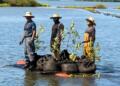
The resolution identifies 16,273 hectares of mangrove forest whose removal is planned for the authorized phase, in addition to 45,352 hectares of secondary vegetation of tropical deciduous forest. Additional impacts are anticipated for the second phase, which are not included in the current authorization.
The executive summary itself acknowledges that the dredging, filling and platform shaping works will modify water circulation patterns and sedimentation processes within basin II.
Among the risks identified are the increase in water residence times in certain areas, the alteration of hydraulic connectivity and the possible generation of lower oxygenation conditions, with effects on aquatic biodiversity.
The importance of these factors lies in the fact that the Cuyutlán Lagoon functions as an interconnected environmental system, whose inner basins are home to mangrove ecosystems, fishing and salt production activities, as well as areas internationally recognized for their ecological value.
Therefore, the DGIRA established obligations related to hydrodynamic monitoring, sediment control, water quality monitoring, wildlife protection, and the implementation of environmental restoration and compensation measures.
The project also incorporates the creation of a Port Environmental Research Center (CIAP) , with a planned area of 7.68 hectares, focused on scientific research, environmental monitoring, ecological conservation and social engagement.
Regarding dredging, the proposal submitted by Asipona considers moving 97.863 billion cubic meters of sediment throughout both phases, a figure that underscores the importance of the conditions related to the transport, handling, and disposal of materials. The overall volume projected should not be confused with the scope authorized solely for the first phase.
An authorization that opens another stage
Semarnat’s decision restores administrative viability to the New Manzanillo Port , but also establishes a development path subject to environmental obligations and new assessments.
The second phase, projected for a long-term horizon, must present another MIA-R that considers the existing environmental conditions when it is intended to be executed, including the cumulative impacts derived from the operation of the initial infrastructure.
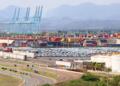
In port terms, Cuyutlán represents a strategic alternative to expand container handling capacity on the Mexican Pacific coast and reduce pressure on the current port of Manzanillo, whose infrastructure faces recurring challenges of connectivity, land saturation, and operational productivity.
However, the new authorization confirms that the growth of port infrastructure no longer depends solely on investment, engineering, and commercial demand. The ability to demonstrate that the works can be carried out without compromising the functionality of the lagoon system will be a determining factor for its development.
After decades of planning and an environmental review process completed just last year, the New Manzanillo Port project once again has an administrative roadmap to move forward. The challenge now is to transform this partial authorization into operational infrastructure, ensuring that environmental conditions do not become a new source of delays or are subordinated to pressures to expand the country’s port capacity.
(Main photo: taken from the MIA-R executive summary)
Comment and follow us on LinkedIn: @Enrique Duarte Rionda / @GrupoT21