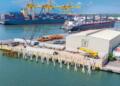




The expansion of port infrastructure in Mexico poses a challenge that goes beyond reducing emissions: preserving the coastal ecosystems that coexist with maritime terminal activity. In Manzanillo, Colima, the Cuyutlán lagoon reflects this tension between economic development and environmental protection.
Faced with this challenge, Contecon Manzanillo is working on a mangrove restoration program in Basin III. To date, the terminal reports planting 15,780 mangroves across 6.5 hectares, with a survival rate of at least 90 percent. To establish them in flooded areas, they used geotextile nets, based on hydrological, hydrodynamic, and salinity studies conducted by the National Autonomous University of Mexico (UNAM).
The project also included the construction of a 580-meter-long raised bed of plant substrate , designed to promote root growth. The plants were transported on rafts to prevent soil compaction in the flooded areas, according to the company’s technical presentation.
“We are not generating plants, we are generating an ecosystem ,” said Angélica Patricia Ruiz Montero, Environmental Management Manager of Contecon, describing the presence of birds and other species in the area where the intervention took place.
This initiative also includes managing an agreement with the National Forestry Commission (Conafor) to conserve another 144.8 hectares, in addition to promoting the participation of local communities in reforestation and conservation activities.
If you wish to continue reading this text that appears in the November edition of T21 magazine, we invite you to review the electronic version by clicking here .
Comment and follow us on LinkedIn: @Alberto Milo / @GrupoT21