SAN LUIS POTOSÍ, SLP. – Thirty-two years ago, San Luis Potosí was the starting point for Scania ‘s story in Mexico . Today, amidst an economic climate that has led companies to hold back or postpone investments, the automaker has returned to the same location to open a new door: its first Scania Used Vehicle Hub in the country.
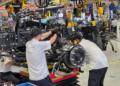
With an investment of 4.5 million pesos , the new space adds 1,500 square meters and 10 service bays intended to inspect, intervene and fine-tune used vehicles before returning them to the market.


Aaron Sanchez, manager of the Altiplano and Western Region of Scania Mexico, explained that San Luis Potosi was chosen as the first point because of its location and connectivity, but the operational objective is what happens before delivering a vehicle again.
“What we are looking for is for this workshop to function in order to guarantee that the purchase of used vehicles […] results in a unit without faults, a unit that is ready for the road,” he said.
And to get back on the road, the units go through a checklist of up to 100 points , divided into five categories that cover safety and operational control, powertrain, diagnostics, chassis, suspension, structure and cab conditions.
The inspection can extend to the vehicle’s inner workings. If necessary, technicians can remove and repair an engine , as well as work on the transmission and differentials before the vehicle is put back on sale.
The return to San Luis Potosí also has a historical component for the company. Gisela Quintero, Director of Customer Experience and Services at Scania Mexico, recalled that it was precisely there where the company began its journey in the country.
But the opening also comes at a time when investment decisions face a less straightforward scenario.
Manuel Aranda, Retail Director of Scania Mexico, acknowledged that the country is experiencing a “quite uncertain” economic situation and that, in such scenarios, companies tend to slow down or postpone investments . In response, he maintained that the company’s strategy has been to maintain investments in infrastructure and customer service capacity.
“At Scania we have been doing the complete opposite; we have been opening new sites, expanding our capacity, hiring more staff, and investing in tooling,” said Aranda, who added that the expansion will continue to increase service capacity in the country.
In addition to infrastructure, another key element for the used car market is knowing the vehicle’s history . During the presentation, it was detailed that 98% of the vehicles considered were covered by a maintenance policy , allowing their service history to be traced through the brand’s workshops.
For his part, David Hernández, National Manager of Used Vehicles at Scania Mexico, explained that the strategy seeks precisely to extend the life cycle of vehicles and support fleet renewal beyond the sale of new units.
“Fleet renewal in the trucking industry doesn’t just depend on selling new units, but also on the ecosystem that surrounds them,” he noted.
The scheme also targets small and medium-sized transport companies looking to incorporate newer vehicles without necessarily acquiring a new unit, in a market where knowing the maintenance, mechanical conditions and costs that may come after the purchase can make the difference.
With San Luis Potosí as its starting point, Scania thus opens a new stage for its used and multi-brand business in Mexico, extending the support of the units beyond their first owner.
Comment and follow us on LinkedIn: @Karina Quintero / @GrupoT21