After the United States approved origin verification for the import of animal protein or meat to Mexico via rail in October 2025, the Mexican government is currently seeking to implement exports of this product using this mode of transport.
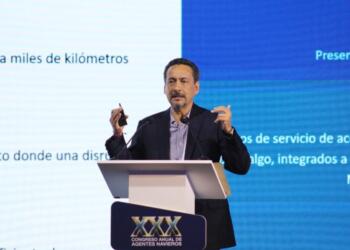
Ximena Juárez Gómez, director of Innovation Projects and Programs at the Quarantine Service of the National Service for Agrifood Health, Safety and Quality (Senasica) , pointed out that the “intention of the railway is that, that the containers return with merchandise that is going to export” .
During a meeting organized by the Mexican Intermodal Transport Association (AMTI) , he added that the organization’s management is also working on the handling of certain products.
He emphasized that several companies are interested in importing other low-risk goods — such as pet food or milk substitute — under this scheme.

He also stated that they are working on an inspection program through inland customs.
“Entering a transit train, arriving at an inland customs office, or clearing the product through customs—which must be low-risk and already undergo certain processes or guarantees that there are no risks associated with merchandise like fresh vegetables or live animals—we are working on this so that we can alleviate congestion at border crossings and carry out these inspections at inland customs offices. We are already working on it,” he emphasized.
Juárez Gómez recalled that the start of the aforementioned service was through the railway company Canadian Pacific Kansas City (CPKC) , with whom 84 import shipments have been made so far , although they are looking to increase the movement.
Furthermore, they have already contacted other railway companies, as well as more exporters, and, with the United States health authority and Senasica personnel, they intend to resolve and implement more options to access this project.
Last October, AMTI reported that Mexican and US authorities approved origin verification for the import of animal protein , which will contribute to building logistical solutions that strengthen the country’s competitiveness and the health security of the supply chain.
Ximena Juárez recalled that this took three years of negotiation with US authorities to carry out the inspection on US territory for goods packaged as meat.
“Verification at origin is verifying, inspecting, and ensuring that goods meet all the requirements already negotiated and established with the country of origin before they leave their center of origin, before they pass through customs or a border crossing. We do this to ensure that they meet all the requirements and to minimize the risk of any disease or pest. In the case of rail, we ensure that it does not stop at the point of entry,” he explained.
The image in the article was created by artificial intelligence.
Comment and follow us on LinkedIn: @Evangelina del Toro / @GrupoT21