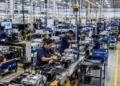
The continued growth in Mexican manufacturing exports is also increasing pressure on companies’ working capital. In May 2026, exports of manufactured goods grew 25.1% year-on-year, but the long payment cycles of international trade represent one of the main challenges for manufacturers to sustain their operations and meet demand, according to Mundi , a company specializing in international trade finance.
According to Mexico’s Merchandise Trade Balance , prepared by the National Institute of Statistics and Geography (Inegi) , exports of manufactured products reached 62 billion 990 million dollars (mdd) in the fifth month of the year, consolidating itself as the main component of Mexican sales abroad.
In this context, Mundi pointed out that the increased export dynamism also increases the need for working capital among manufacturing companies to meet new orders without affecting their operations .
However, this growth does not eliminate one of the main challenges for companies in the sector: maintaining sufficient liquidity to finance the purchase of inputs , production and payroll while waiting for payment for their exports, whose cycles can extend up to 180 days.
“The manufacturing sector in Mexico has world-class technical capabilities that compete globally. All this at a time when payment cycles can extend up to 180 days and bank credit for foreign trade operations remains limited for small and medium-sized enterprises (SMEs),” said Carlos Missirian, VP Business Development at Mundi.
An example of this need for liquidity is Dincosa , a company located in Chihuahua dedicated to the manufacture of bolted structures, mechanical equipment and specialized sheet metal for the mining, oil and gas, processing industry and data center sectors, which exports to the United States, Central America and Asia.
Alejandro Hernández, general manager of Dincosa, explained that several months can pass between receiving a purchase order and receiving payment, a period during which the company must continue acquiring materials, producing and covering its operating costs.
“During that time we need to continue buying supplies, producing and paying payroll,” Hernández stressed.
This scenario shows that export growth depends not only on international demand but also on companies’ financial capacity to sustain operations while completing their payment collection processes . For manufacturers, having timely access to working capital can mean the difference between fulfilling new orders or limiting their growth due to a lack of liquidity.
In this context, timely access to working capital is emerging as a key factor for manufacturing companies to take advantage of the growth in international demand without compromising their operations.
Having liquidity to finance inputs, production and delivery times will be key for more manufacturers to maintain their competitiveness and expand their presence in export markets.
Comment and follow us on LinkedIn: @GrupoT21