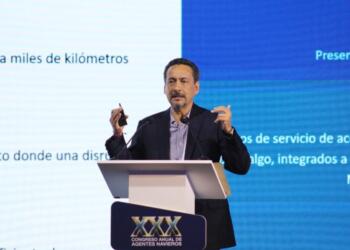
Amid global uncertainty, geopolitical tensions, and internal pressures, analyst Mauricio Candiani warned that 2026 will be a year of “crosswinds” for companies in Mexico, where the key will not be waiting for certainty, but making strategic decisions with pragmatism.
During his presentation at the ANERPV Forum , Candiani used a metaphor comparing the current economy to a turbulent flight. While some react nervously to any jolt, more experienced organizations understand that these episodes are inevitable and operate with clear protocols.
“This is how things are this year; there are slight movements and stronger ones that directly impact the dynamics of businesses, regardless of the sector,” he explained.
One of the main challenges, he pointed out, is the low economic growth . Mexico is advancing at a “baby step” pace, insufficient in the face of key variables such as population growth or the level of public debt.
According to Candiani, the country should grow above both indicators to guarantee long-term stability, something that is not currently happening. This is compounded by a still-high fiscal deficit and a growing debt, which, while not critical, does show a worrying trend.
“The problem is not the size of the debt, it is the trajectory,” he warned.
On the monetary front, he highlighted that the reduction in interest rates represents an opportunity for investment, although he stressed that its impact goes beyond credit: it also directly affects the viability of new projects.
Regarding inflation , the specialist pointed out that it does not represent a serious macroeconomic risk at the moment, as it remains within manageable ranges for the economy.
One of the most critical points of his analysis was the global energy environment, which he described as a “shock” driven more by expectations than by physical scarcity.
In this context, he warned about Mexico’s high dependence on natural gas imported from the United States, which could become a structural risk in the event of supply disruptions.
However, it also identified opportunities, particularly in the development of unconventional gas in the north of the country, driven by changes in energy policy.
“The restriction is not the price, it is the capacity,” he emphasized.
Nearshoring and unequal opportunities
Candiani acknowledged that regionalization and trade with the United States remain key drivers for Mexico, especially within the context of the United States-Mexico-Canada Agreement (USMCA) . However, he cautioned that the benefits are not distributed evenly.
While some regions and industries are growing rapidly due to the relocation of production chains, others are facing lags or even contractions.
“The world is in constant arbitrage of inputs, and Mexico is well positioned to take advantage of it,” he noted.
Another area of concern is the judicial system . Candiani warned about a transition process that could generate greater uncertainty in dispute resolution, forcing companies to rethink their legal and compliance strategies.
He even warned about the strengthening of regulatory powers that allow accounts to be frozen based on presumptions, which increases operational risks .
Beyond the diagnosis, Candiani’s central message was that companies must adjust their decision-making to a reality where government support is limited.
“We have to ask the government as if it could do everything, but in the boardrooms we have to make decisions as if it weren’t doing anything,” he said.
In this regard, he called for maintaining financial discipline, avoiding overleverage, and strengthening the capacity to adapt to changing scenarios.
Despite the challenges, the specialist concluded with a moderately optimistic outlook. He asserted that Mexico maintains significant competitive advantages , especially in sectors related to exports, logistics, and technology.
“The country is in the right postal code ,” he said, noting that opportunities exist, but depend on companies’ ability to read the environment, adjust their strategies, and execute with discipline.
Comment and follow us on LinkedIn: @Jennifer Galindo / @GrupoT21