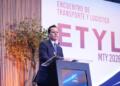
In a context of global supply chain reconfiguration, Mexico seeks to consolidate its role as a strategic hub in international trade . This was stated by Ignacio Aguado, Director General of Innovation, Services, and Domestic Trade at the Ministry of Economy , as he highlighted the main lines of action of the so-called Mexico Plan .
During his participation in The Logis World Summit & Expo, the official emphasized that the country has a key structural advantage: its integration with North America. In this regard, he stressed the need to strengthen the relationship with the United States and Canada, not only to maintain trade dynamism but also to boost regional competitiveness.
“The goal is to consolidate Mexico as a strategic hub for advanced manufacturing, logistics, and foreign trade,” he said.
Aguado explained that the nearshoring phenomenon (relocation of production lines) is already generating tangible results for Mexico, although he warned that the real challenge lies in maximizing its potential .
To achieve this, the Mexican government seeks to position itself as a facilitator of investment, generating conditions of certainty and confidence for both foreign and domestic capital.
In that context, he highlighted that sectors such as automotive, semiconductors and information technologies are emerging as priorities, without neglecting the need to promote the development of all industries through a strategy based on regional vocations.
“We also need to motivate Mexican companies, SMEs (small and medium-sized enterprises), to grow and integrate into value chains,” he noted.
Infrastructure, talent and regulation: the major challenges
The official acknowledged that, despite projected growth, Mexico faces significant challenges, especially in logistics infrastructure, human capital, and energy capacity .
According to estimates from the Ministry of Economy, the logistics sector could grow by up to 30% by 2030. However, there is currently a deficit of between 25% and 30%, which necessitates accelerating the sector’s development.
“We cannot grow at 7% or 8% annually; we need to grow at double that rate to meet the needs of the region,” he warned.
He also pointed out the urgency of strengthening talent training and certification , particularly in critical segments such as trucking, where there is a high demand for drivers.
According to the National Chamber of Freight Transportation (Canacar) , Mexico has a shortage of more than 90,000 truck drivers , a situation that could worsen in the coming years, since if the trend continues, by 2028 the figure could exceed 110,000 drivers.
One of the central pillars of the Mexico Plan is to achieve more balanced growth across regions. To this end, the government is promoting the so-called Economic Development Hubs for Well-being , which aim to decentralize investment and leverage local capabilities.
Aguado exemplified this challenge with the case of data centers, which, although there is high interest in setting up in states like Querétaro, the lack of infrastructure limits their growth, so their expansion to other entities with better conditions is being promoted.
“It’s about directing investment towards where there are available resources, infrastructure and talent,” he explained.
USMCA and global positioning
In the international arena, the official highlighted the importance of the United States-Mexico-Canada Agreement (USMCA) , which he described as the most successful trade agreement in the world, representing nearly 30% of global Gross Domestic Product (GDP).
In the midst of its review process, Mexico, he asserted, comes with solid arguments and a strategic position, backed by its role as a key partner for the United States in the context of global competition .
Aguado emphasized that logistics has become a fundamental pillar for economic development, especially after the COVID-19 pandemic, which highlighted its relevance in supply chains.
In response, the Ministry of Economy is promoting initiatives such as Ruta Logística MX , a public policy focused on the professionalization of the sector, talent development, and the link between industry, academia, and government.
“The country’s growth cannot be achieved in isolation. It requires a joint effort between the public sector, the private sector, and academia,” he emphasized.
Comment and follow us on LinkedIn: @Jennifer Galindo / @GrupoT21