



Will the national transport strike continue? The question arises this Tuesday, October 27, as the movement enters its second day, after the organizing groups called for increased mobilizations starting at 7:00 a.m. and, during the early morning, announced that they would begin dialogue sessions with the Ministry of the Interior (Segob) .
Through a statement released by the National Chamber of Freight Transportation (Canacar) , along with other organizations in the sector, the start of meetings with the Ministry of the Interior (Segob) was announced, although the time was not specified nor was there any information about the suspension of the protests .
The announcement came hours after Carlos García Álvarez, national president of the Honorable Mexican Alliance of Transport Organizations (HAMOTAC) ; Augusto Ramos, president of Canacar; and Lauro Rincón Hernández, national president of the Mexican-American Federation of Transporters (FEMATRAC) and the Integrating Organization of Conventional Rights (INDECO) asked the transporters to continue with the mobilizations and reinforce their presence on the highways from 7:00 a.m. this Tuesday, October 27.
Some participants decided to spend the night at their meeting points, while others withdrew for safety reasons, with the intention of returning on the second day.
In the message released on the night of Monday, October 26, the leaders also questioned the movement’s representation in meetings with the authorities.
“We need these dialogue tables to be an agenda coordinated by the freight transport sector, not by other organizations,” they stated during the pronouncement.
The demand arose after federal authorities held meetings with representatives of the Confederation of Industrial Chambers (Concamin) , the National Chamber of Passenger and Tourism Transportation (Canapat) , the National Confederation of Mexican Transporters (Conatram) and the National Association of Private Transportation (ANTP) , without these approaches resulting in the lifting of the strike announced since Friday, October 23.
The movement responds to a problem that truckers say they have repeatedly reported: cargo theft, attacks against drivers, extortion, protection rackets, and operating costs that make it difficult to keep their vehicles running . Added to this are the poor condition of the road infrastructure and regulatory requirements.
The consequences extend beyond transport companies. Uncertainty surrounding the protests is forcing stakeholders in the logistics chain to review routes and anticipate potential delays in the transport of goods, although the specific impacts depend on traffic conditions in each corridor.
Sheinbaum focuses on fiscal stimulus
Amid the protests, Mexican President Claudia Sheinbaum Pardo addressed the conflict during her morning press conference on Monday, October 26, and emphasized a modification to the tax incentive related to toll payments on highways, whose income limit to access the benefit would be lowered from 300 to 250 million pesos annually.
The governor indicated that, according to her administration’s calculations, the measure would affect 170 companies . Although she acknowledged the problem of highway insecurity and assured that coordination mechanisms exist with the relevant authorities, her explanation regarding the tax component contrasted sharply with the demands of the truckers.
Industry estimates also questioned the scope of that figure. Based on the monthly directive bulletin from the Ministry of Infrastructure, Communications and Transportation (SICT) , corresponding to August 2026, carriers calculated that 6,996 companies could be excluded from the incentive , considering the size of their fleets.
The official document lists 5,450 medium-sized companies, with between 31 and 100 units, and 1,546 large companies, with more than 100 units. The potential exclusion from the benefit is based on an estimate by the carriers themselves, not on an official tax registry.


However, the discussion about tax incentives is only one part of the grievances that sparked the strike. The organizers maintain that their main demands include combating crime on highways, addressing extortion, and implementing measures that allow drivers to complete their routes without jeopardizing their safety .
In this scenario, the announcement of the dialogue tables with Segob represents a new step in the conversations between the convening organizations and the federal authorities, although the specific topics to be addressed and the possible commitments have not yet been made public.
Thus, the second day of the strike begins with a call to maintain the mobilizations and the announcement of negotiations with the Ministry of the Interior , without the organizations having officially announced the end of the movement.
Attention is now focused on the results of these meetings and on the response that the authorities can offer to the demands of a sector that is calling for security conditions to keep the country’s goods moving .
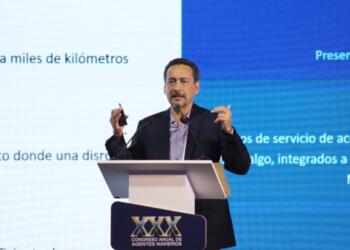
Image source: HAMOTAC .
Comment and follow us on LinkedIn: @Karina Quintero / @GrupoT21