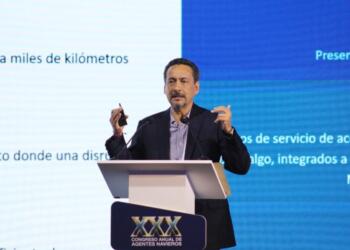
Artificial intelligence (AI) in the trucking industry is no longer an aspirational concept or a technological fad; it is a reality and a prevailing concept that must be addressed. This was the motivation behind the 3rd Trayecto Forum , where the impact of this tool was discussed, along with how truck and technology suppliers are incorporating it.
Hernán Guerra, IT director of Trayecto (number 1 in the Top 100 of Autotransport® ), was responsible for moderating the conversation, whose central idea was: AI is already directly impacting the efficiency, profitability and safety of the sector .
The participants’ approach focused on showcasing real-world examples, measurable results, and a pragmatic view of technology adoption. Rather than making futuristic predictions, the conversation centered on how AI is helping to make better decisions, reduce uncertainty, and transform processes that have historically been reactive.

From prevention to profitability
One of the greatest contributions of artificial intelligence is consistency in decision-making. In an environment where each truck generates tens of thousands of data points, AI makes it possible to identify patterns, anticipate failures, and prioritize risks without relying on subjective judgment , said Jorge Vargas, Strategy Director of Daimler Truck Mexico .
Predictive maintenance was one of the clearest examples. Servicing a unit before it fails can extend its lifespan by up to 30% and generate savings of between 18% and 25%, in addition to improving capital utilization. In practice, AI functions as a preventative system that “diagnoses” the vehicle before the problem becomes critical.
This approach also extends to route allocation, trip balancing, and empty mileage reduction, relying on algorithms that constantly learn and are fed by external data such as maps, traffic, and weather conditions. The ultimate goal is clear: greater operational efficiency and consistent decisions that directly impact profitability.

AI from manufacturing and operations
Artificial intelligence doesn’t just act when the truck is already on the road, but from much earlier, in the design and development phases , as shared by Javier Valadez Ortega, Director of Operations at PACCAR Mexico .
The use of virtual reality, mixed reality, and AI allows for the simulation of components, the validation of aerodynamics, and compliance with regulations without the need to build physical prototypes, reducing time and costs. Seemingly minor adjustments, such as mirrors or deflectors, can generate fuel savings of up to 2%, a significant figure when scaled to entire fleets, Valadez Ortega added.
Furthermore, AI is already being used to simulate engine behavior at different altitudes and under varying conditions, optimizing performance in complex geographies like Mexico. This demonstrates that decarbonization is not limited to electrification, but rather involves optimizing every variable that impacts fuel consumption .
In day-to-day operations, Javier Valadez highlighted another immediate benefit: administrative automation . Processes such as CFDI ( Digital Tax Receipt via Internet) , customs declarations, and foreign trade registrations can reduce operating time by up to 80%, freeing up resources for strategic activities.
Digital agents, security and culture
The panel also addressed how AI is transforming everyday logistics operations. Marcos Diehl, head of Latam at HappyRobot , demonstrated how digital agents are already performing complete tasks: scheduling appointments, handling incidents, negotiating loads, coordinating shipments, and managing collections, without constant human intervention.
Specific cases demonstrated dramatic reductions in time and costs, as well as improvements in service levels. AI not only recommends, but also acts, becoming a digital workforce that operates 24/7 and scales according to demand.
In terms of safety, the conversation was particularly relevant. Trayecto and HappyRobot agreed that prevention is AI’s greatest value. From internal cameras that detect fatigue, seatbelt use, or unauthorized presence , to systems that validate identity by voice or face and activate automatic protocols, the technology is already helping to significantly reduce theft and accidents.
However, the biggest challenge is not technical or financial, but cultural. Adopting artificial intelligence requires training, awareness-raising, and clear communication with operators and administrative staff. AI is not meant to replace people, but to reduce their operational workload and allow them to focus on critical decisions.
The conclusion: artificial intelligence is already transforming trucking , but its true value depends on how it’s integrated into operations. It’s not about buying technology, but about understanding it, adapting it, and turning it into a business enabler.
Comment and follow us on LinkedIn: @Didier Ramírez Torres / @GrupoT21