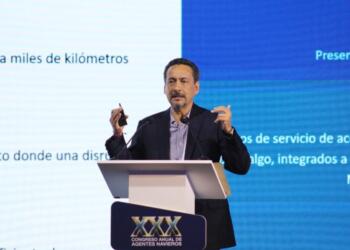
The challenges in trucking security no longer revolve around whether a robbery will occur, but rather how prepared the sector is to confront it. In Mexico, this crime occurs with a frequency that is no longer exceptional: according to specialists, a highway robbery against truckers is recorded every 30 minutes , reflecting an environment where operations are carried out under constant risk .
The problem persists and evolves. Criminal gangs operate with greater organization , change routes , use signal jammers, and adjust their tactics in response to police operations , forcing companies to rethink their security strategy practically in real time, Ángeles Useche, commercial director of Total Protect , told T21 .
But the biggest obstacle isn’t always external. It’s also internal. Despite this scenario, a portion of the sector continues to operate with traditional methods : calls to the operator, Excel spreadsheets, or reactive decision-making. Resistance to adopting technology remains one of the main hurdles, even though more accessible models exist today, the specialist explained.
The change, in reality, is one of mindset. Safety has ceased to be an expense and has become a condition of operation .
From the technological front, the evolution points to building layers. GPS alone is no longer enough. The approach now integrates video surveillance, engine immobilizers, sensors, and predictive analytics to anticipate risks, said Useche. That’s the turning point: moving from reacting to predicting.
In practice, the numbers illustrate the scale of the challenge. Among the company’s clients, four to five cargo thefts are recorded weekly . However, when technology and monitoring are integrated, recovery rates can exceed 97% , a difference that lies not in the event itself, but in the response capacity, he indicated.

The window of opportunity is in the first few minutes. According to Useche, the use of platforms with predictive intelligence is starting to make a difference. Identifying schedules, routes, and risk patterns allows for decisions to be made before the incident occurs, not after.
This is complemented by coordination with authorities and monitoring centers such as C4 and C5, as well as specialized response teams, which increase the chances of recovery and reduce the operational impact.
In a context where crime does not stop, security is no longer an add-on, it is part of the business.
Comment and follow us on LinkedIn: @Karina Quintero / @GrupoT21