In a complex global environment, marked by disruption, cost pressures and increasing regulatory sophistication, the freight forwarder has ceased to be an operational actor and has become a true articulator of the supply chain.
Their role, although often invisible to the end customer, is crucial for foreign trade to function smoothly.
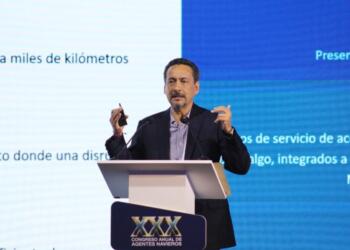
This was explained by Eva María Muñoz, president of the Mexican Association of Freight Forwarders (Amacarga) , who defined the freight forwarder as the businessman in charge of managing the integral movement of merchandise , from its origin to its final destination.
This task involves much more than coordinating a transfer: it involves designing a complete logistics strategy that considers routes, times, costs, regulations and risks.
In practice, the freight forwarder is the one who translates the complexity of international trade into concrete operational solutions. From choosing the mode of transport—air, sea, or land—to defining the appropriate packaging, managing permits and certifications, and coordinating customs clearance, their involvement is integral to the entire operation.
To achieve this, it brings together various actors such as carriers, shipping lines, airlines, customs agents and authorities
“Their goal is to ensure that the customer receives the merchandise from point A to point B without any problems,” Muñoz summarized to T21.
This seemingly simple premise encapsulates one of the greatest challenges of modern logistics: ensuring operational continuity in an environment where any disruption, from a port delay to a regulatory change, can generate significant costs.
Therefore, the value of a freight forwarder lies not only in execution, but also in the ability to anticipate and make decisions . Evaluating alternatives, optimizing routes, negotiating rates, and anticipating risks are tasks that directly impact the competitiveness of companies.
In this sense, their role has evolved into that of a strategic advisor, capable of supporting clients in their logistical and commercial decision-making. Furthermore, their involvement allows companies to focus on their core business.
“The client can focus exclusively on producing, importing or exporting, while the freight forwarder takes care of the entire operation,” Muñoz pointed out.
This delegation not only simplifies processes, but also reduces exposure to errors, non-compliance, or cost overruns
In markets like Mexico, where the dynamism of foreign trade is combined with highly complex regulations, this role becomes even more crucial. The proper management of documents, regulations, and timelines can make the difference between a successful operation and a vulnerable supply chain.
However, in a sector with multiple players and a growing supply of services, identifying the most reliable and efficient freight forwarders can be a challenge.
In this context, Grupo T21 has launched the first freight forwarder index in Mexico , the Top Freight Forwarders Index , in conjunction with Amacarga , an initiative that seeks to bring transparency to an environment where information overload creates noise and makes it difficult to distinguish who’s who within the industry.
This index represents an effort to organize the market, provide greater clarity for users, and recognize companies that are raising industry standards. At the same time, it paves the way for greater professionalization and competitiveness among logistics players.
As part of this initiative, the Freight Forwarder Awards will be held on May 29th , an event that seeks to recognize the country’s most outstanding freight forwarders. Beyond the awards ceremony, the event highlights the importance of these players in the supply chain and reinforces a key message: behind every successful logistics operation lies strategic, coordinated, and often invisible work.
At a time when resilience and efficiency are paramount, freight forwarders are becoming indispensable partners for companies involved in international trade. Their ability to simplify complexity, optimize resources, and ensure the smooth flow of goods positions them as one of the less visible, yet most critical, pillars of the global economy.
Comment and follow us on LinkedIn: @Jennifer Galindo / @GrupoT21