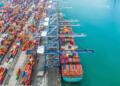
In a decade, Mexico’s maritime landscape shifted dramatically. Trade with Asia gained momentum, Pacific ports absorbed larger container volumes, and supply chains began demanding more than just shipboard space. Against this backdrop, Cosco Shipping Lines Mexico quadrupled to quintupled its operations and is now preparing for a new phase, aiming to expand its presence from maritime transport into land-based transportation and other logistics solutions.
This evolution coincides with a structural growth in trade between Mexico and China, which, according to Mateo Cepeda, Senior Sales & Export Manager of Cosco Shipping Lines Mexico, allowed the company to move from a secondary position to becoming one of the main participants in container shipping in the country, particularly on the Pacific.
The starting point was 2016, although a broader transformation lay behind it. The global integration of Cosco Shipping and China Shipping occurred after one of the most turbulent periods for the maritime industry, characterized by overcapacity, falling rates, and a wave of mergers and consolidations among shipping lines. The integrated operation in Mexico began on July 15 of that year, after combining systems, vessels, container inventories, and portfolios that had previously operated separately.
But the company’s transformation cannot be explained solely by that merger. At the same time, Mexico increased its dependence on Asian supply chains , and the containerization of the transpacific route gained momentum.
This move transformed the country into a central part of Cosco’s regional network. Cepeda stated in an interview with T21 that more than half of the cargo originating in the Far East within the market the company serves on the west coast of Latin America is destined for Mexico , while all of its transpacific services in this region make stops at Mexican ports.
Manzanillo occupies a particularly relevant position : 100% of Cosco’s services on this network touch that port, while other routes incorporate Ensenada and Lázaro Cárdenas before continuing towards Colombia, Peru and Chile, with Chancay, operated by Cosco Shipping Lines, being incorporated as a new node for the connection with Asia.
“Mexico is the main driver in terms of cargo volume,” Cepeda said, explaining the importance the country has acquired within the shipping company’s regional structure.

The expansion, however, is no longer focused exclusively on the Pacific. A decade ago, Cosco’s Mexican operation was almost entirely concentrated in Manzanillo, with only occasional services in Lázaro Cárdenas. Since then, it has added Ensenada and extended its service to Altamira and Veracruz , from where it operates routes to Europe, the Caribbean, and the east coast of South America. It has even begun deploying its own vessels on some of these routes, after previously operating through partnerships with other carriers.
This growth is also reflected inland. From approximately 30 or 40 employees in 2016, Cosco Shipping Lines Mexico now has over 140. This growth has been further enhanced by the addition of its own offices in Manzanillo and Ensenada, a commercial presence in Monterrey, Querétaro, and Guadalajara, and operations through agents in Lázaro Cárdenas, Altamira, and Veracruz.
Behind this geographical distribution also lies the way Mexican foreign trade has been structured . While around 85% of the country’s exports go to the United States and Canada, a significant portion of maritime imports come from the Far East. For shipping companies, this structure creates an imbalance that Cepeda estimates at between four and five import containers for every one maritime export container.
The response has been to seek Mexican cargo that allows them to utilize equipment that must be returned to other markets. Electronics, appliances, auto parts, vehicles, cotton, minerals, beer, and refrigerated products are among the segments where the company has sought to develop exports, although Cepeda currently identifies an additional obstacle: the strength of the peso, which can reduce the competitiveness of some Mexican products in international markets.
It is precisely on land where Cosco sees one of its greatest areas for future growth . The location of major industrial and consumer centers far from the coast necessitates complementing maritime transport with road and rail connections. The strategy involves increasing the proportion of shipments in which the shipping company itself incorporates land transport into the bill of lading and determines, together with the customer, which combination of port, rail, or trucking is most suitable.
“We increasingly want to be a player in the supply chain and be able to provide comprehensive solutions to customers, not just in the maritime sector,” Cepeda explained.
The expectation is that, within the next few years, a considerable proportion of its containers will incorporate value-added services beyond the maritime leg. “We don’t just see ourselves as a company whose core is the sea, but also land, ground transportation, trucks, and trains,” he added.
This gamble comes as cargo growth begins to encounter the limitations of Mexico’s infrastructure . Cepeda notes that the Pacific remains the primary driver of the country’s maritime trade, but also identifies bottlenecks that could limit the capacity to absorb new volumes.
According to the executive, this tension is also a consequence of the speed at which the market has grown. “Part of the challenge has been seeing how we can, within that growth, keep up or keep pace with the growth in terms of infrastructure ,” he noted.
Cosco’s outlook is that demand will continue. Nearshoring , it argued, does not necessarily diminish trade with Asia: new plants established in Mexico require machinery, components, and raw materials from the Far East , which can ultimately generate greater transpacific shipping needs. Even in light of the North American trade negotiations, the shipping company anticipates that Mexican demand will maintain a growth trajectory in the medium and long term.
The immediate outlook, however, remains volatile. Cepeda identified pressures on tariffs stemming from fuel costs, tensions in the Middle East, disruptions related to the Red Sea and the Strait of Hormuz, and blank sailings that temporarily reduce the effective availability of space.
This reveals a paradox of current maritime transport : while shipping companies continue to add capacity, some of it cannot be deployed normally due to geopolitical conflicts, energy costs, and route changes. At the same time, Mexican demand remains strong. According to data cited by Cepeda during the interview, Pacific cargo was growing by nearly 6%, compared to a contraction of approximately 7% in the Gulf and an overall increase of around 2%.
The company has also undergone another, less visible transformation: the digital one . Processes that a decade ago relied on emails, documents, and manual procedures migrated first to e-commerce platforms and later to more sophisticated technological tools. Among these is GSBN , a blockchain- based platform used to accelerate cargo release processes, which is already operating in Mexico.
Digitalization and integrated logistics will be accompanied by a third pillar: decarbonization. Cosco has begun incorporating methanol-powered vessels, and Cepeda anticipates that this fleet transformation will have an increasingly significant presence in operations linked to Mexico. At the same time, artificial intelligence and new digital platforms should facilitate customer reservations and management without eliminating human contact, he asserted.
The scale of this change can also be seen in the ships. When integrated operations began in Mexico, Cosco relied on shared services with other shipping lines; in 2018, it launched its first service operated entirely with its own vessels, and in 2024, it added a second. This is further complemented by its participation in Ocean Alliance , which emerged in 2017.
Thus, the first 10 years were marked by the consolidation of services, routes, offices, and volume ; the following years point toward a different transformation. The strategy is no longer solely about increasing capacity between Asia and Mexican ports, but about capturing a larger share of the supply chain that begins or ends behind them.
“Growth, continued confidence in Mexico, continued investment,” Cepeda summarized regarding the company’s outlook, but now with three components that will define that expansion: door-to-door services, digitalization, and decarbonization .
Comment and follow us on LinkedIn: @Enrique Duarte Rionda / @GrupoT21