MAJALCA, CHIH.- Fatigue sets in during a night’s journey. After hours behind the wheel and with the cargo still far from its destination, stopping to rest would seem logical, but for truck drivers, finding a safe place to do so remains one of the challenges on the country’s highways.
The problem combines two risks that coexist during the journey : fatigue accumulated from long hours of operation and the insecurity that can arise when stopping. Finding a place to pause also involves considering the driver’s safety, the security of the truck and the cargo, making rest a necessity that is not always easy to fulfill.
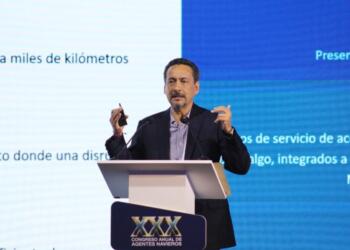
This is the reality that drivers constantly express, hence the need to create safe spaces for them. The private sector achieved this; on this occasion, it was OXXO Gas , which, in coordination with the Ministry of Infrastructure, Communications and Transportation (SICT), inaugurated the first OXXO Gas Safe Stop, a Travel Center with Comprehensive Services, in Majalca, Chihuahua, which had been announced in recent days by the federal government.


The space aims to concentrate in one place conditions for the safekeeping of units and goods, as well as services that allow operators to stop and rest before continuing their journey .
The need is not lost on those behind the wheel. During the inauguration, one of the operators recounted that he cannot stop just anywhere on his routes for safety reasons and recalled that he has even been the victim of assault and the theft of a truck.
“This project was designed to benefit the carrier, understanding the needs and challenges they face on the road,” explained Carlos Aguirre Quiroga, B2B director of OXXO Gas, in an interview with T21.
The executive pointed out that the objective goes beyond fuel supply, aiming to provide operators with the necessary services to rest and continue their journey in one place.
The complex required an investment of over 100 million pesos (MXN) , occupies more than 35,000 square meters (m²) , and is expected to benefit around 480,000 users annually . Aguirre explained that approximately 13,000 vehicles , including heavy trucks and light vehicles, pass through this area daily.
The rest stop has capacity for 37 units, including full configurations , in addition to six or seven temporary spaces for stays of between 30 minutes and one hour, intended for those who only need to use some service before continuing their journey.
This site offers rest areas, restrooms, showers, laundry facilities, food options, fuel, and mechanical assistance. During the tour of the facilities, it was reported that there are 10 showers, eight for men and two for women .
Resting is also part of road safety
Beyond the protection of the units and goods, the opening of the complex brought to the table another component of road safety: the conditions available for operators to comply with their rest periods.
“Rest is also part of road safety,” said Alex Theissen, president of the Board of Directors of the National Association of Private Transportation (ANTP) .
Theissen explained that a safe road depends not only on the conditions of the infrastructure, signage or vehicles, but also on having places that allow operators to stop, rest and then continue their journey in suitable conditions.
In that regard, Tania Carro Toledo, Undersecretary of Communications and Transportation of the SICT, recalled that NOM-087 establishes maximum driving times and mandatory rest periods for operators.
The official stated that compliance with these periods helps reduce the risk of accidents associated with fatigue and protects both operators and other road users.
But rest isn’t just about having a place to stop. The safety of the driver, the vehicle, and the cargo are the other components the rest stop aims to address.
In that regard, Carlos Aguirre also explained that the complex has access control, cameras, and private security. Furthermore, a barracks for the National Guard was built , with the intention of ensuring a permanent presence of its personnel on the premises.
These measures are complemented by private security patrols and video surveillance, while the parking facility allows cargo units to remain within the complex during rest periods.
The location also takes into account the area’s logistical flow . The project is situated near Federal Route 45, which connects Chihuahua with Ciudad Juárez, identified by the SICT as one of the main corridors for the movement of people and goods to the northern border, Aguirre explained.
More inns in the sights
The opening in Majalca is part of the actions announced days ago by the federal government to strengthen highway safety, including the implementation of the C4 Highway Command Center and the development of a network of 15 safe rest stops. The OXXO Gas complex is the first of these locations to become operational.
Carro Toledo explained that, after this first opening, the SICT has authorization to continue with the development of the executive project for nine other rest stops , while five additional ones are in the process of review, to complete the 15 contemplated.
OXXO Gas has not yet decided where its next project will be located. Aguirre explained that the company is analyzing its network of service stations and various highways to identify locations where the concept could be replicated.
“We are conducting analyses to understand what the next rest stops we could build might be,” he said.
For now, he added, the priority will be to ensure that the Majalca complex meets the needs of the transporters before moving on to other locations.
For Theissen, the need goes beyond a facility.
“Mexico needs a network of safe rest stops that supports the growth of its logistics activity and at the same time recognizes the fundamental role of those who travel our roads every day,” he said.
Comment and follow us on LinkedIn: @Karina Quintero / @GrupoT21