JIUTEPEC, MOR.- The conversation about the future of trucking began with a call to accelerate modernization , strengthen sustainability, and maintain coordination between industry and government . This marked the opening of the 4th Sustainable Mobility and Technology Meeting, organized by the National Association of Private Transportation (ANTP) , a forum that aims to translate trends into concrete actions for the sector.
From the outset, the central message was that freight transport faces a transformational environment , where technology, the environment, and operational efficiency are no longer separate issues, but part of the same agenda.
The meeting, which has become established as a space for dialogue on public policies and technological advances , seeks to share best practices and open new training routes for companies in the sector.
In this context, Leonardo Gómez, executive president of the ANTP, highlighted that environmental protection has become an operational pillar of the trucking industry, which requires continuous improvement in how companies conduct their operations and adopt new technologies.
Sustainability , he explained, not only responds to a regulatory requirement, but also to the need to make logistics operations in the country more efficient and competitive, in an environment where challenges and opportunities are advancing simultaneously.
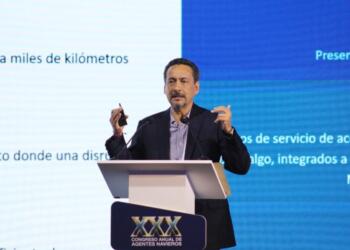
This approach was complemented by the authority’s perspective. Luis Ruiz Hernández, head of the General Directorate of Federal Motor Transport (DGAF) of the Ministry of Infrastructure, Communications and Transportation (SICT) , put the sector’s role into perspective: “Motor transport covers an estimated 800 million kilometers daily along more than 50,000 kilometers of highways , moving essential goods for the economy and daily life,” he emphasized.
Under this scenario, he emphasized that the coordination between the ANTP and the SICT has allowed progress in key actions to address the operational challenges of the sector, from the digitization of procedures to regulatory strengthening.
Among the highlighted lines of work are the simplification of administrative processes, the modernization of service stations, the supervision of weights and dimensions , as well as the promotion of self-regulation through regulatory compliance certifications.
In his speech, he also highlighted the joint work on security and the implementation of programs such as the identification of units through the Public Vehicle Registry (Repuve), in addition to actions to strengthen technical supervision on the road.
One of the central points on the agenda was the renewal of the vehicle fleet. Ruiz Hernández commented on the fleet renewal program announced by the Ministry of Economy , and reiterated that the federal government has a guarantee fund exceeding 400 million pesos (MXN), with the capacity to leverage more than seven billion MXN in financing to modernize the fleet.
This program, which is in the guidelines phase, aims to promote more efficient units with lower emissions, he explained.
In addition, Ruiz recalled that the previous meeting had already identified priorities such as emissions reduction, intermodality, the circular economy and vehicle renewal , issues that are relevant again in this edition.
With this start, the meeting opens the way to an agenda that not only seeks to discuss trends, but to translate them into concrete actions for a sector that continues to be the main system of goods mobility in Mexico.
Comment and follow us on LinkedIn: @Karina Quintero / @GrupoT21