CANCUN, Q. ROO.- 2025 was marked by uncertainty generated by tariff decisions and the economic problems faced in various regions of Latin America.
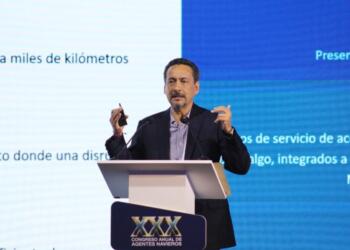
In this context, Cummins ‘ results in the first quarter showed a 3% increase in sales compared to the same period in 2025, where it is noteworthy that Mexico and Latin America maintained their 6% share of the corporation’s overall results, which, according to Jorge Machuca, leader of the Engine Segment for Cummins Hispanic America, is a positive result for the region.
In addition to maintaining its participation in the corporation’s global results, Machuca highlighted that despite the “noise” that may have been generated with the renegotiation of the Treaty between Mexico, the United States and Canada (USMCA), the country has benefited from investments and it is expected that more resources and operations will be channeled to the national territory .
“During 2025, in complex times, nine million dollars (mdd) were allocated to activities in Mexico, purchases have increased and the manufacturing plants in San Luis Potosí, Ciudad Juárez, Monterrey and Guadalajara have been consolidated,” Machuca added.
In this regard, Lucía López, commercial director of Cummins, stated that the corporation regionalizes manufacturing, so the components required in Latin America are produced in this same area, favoring operations in these countries .

Jorge Machuca explained that in addition to manufacturing, they are repositioning some service areas that were mainly located in Asia, and which are focused on service issues. “It’s not just manufacturing; there are centralized areas we have, such as finance, information technology , among others, and we are constantly analyzing what opportunities there are to move some operations from one place to another.”
Portfolio diversification
Given the current energy situation in Mexico, Cummins specialists stated that the use of diesel should not be “demonized,” as it is the most viable option for promoting the decarbonization of road transport.
Lucía López specified that after the X15 engine was introduced in the second half of 2024, it is estimated that by the end of 2026 there will be approximately 20,000 units in operation.
Within this same family, there is the X15N (natural gas) and it is estimated that by 2026 there will be 650 units in circulation, where when analyzing the Total Cost of Operation (TCO), in some cases it turns out to be a better option for the transport sector.
For the mid-range, the B6.7 and L9 engines are integrated for all types of operation. “The B6.7 is the best-selling engine in Latin America precisely because of the versatility it offers,” López noted.

Regarding the powertrain complement, Federico García, Director of Sales and Service for Cummins Drivetrain and Braking Systems, highlighted that the RT-160 HE rear axle will be in production by the end of this year and the beginning of 2027 , “among its advantages is using 5.1 liters less oil, impacting operating costs.”
From the perspective of managers, in order to make evident the benefits of fleet modernization by incorporating more up-to-date and safer components, the key is to be close to verify in the field the results obtained and the competitive advantages that can be offered.
Comment and follow us on LinkedIn: @Didier Ramírez Torres / Sent / @GrupoT21