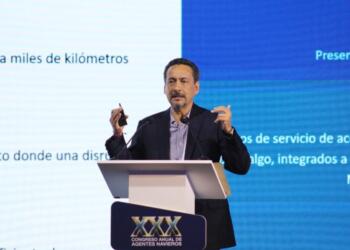
The College of Civil Engineers of Mexico (CICM) and the Mexican Association of Railways (AMF) signed a collaboration agreement to promote training , knowledge exchange and joint work between both organizations.
Jesús Campos López, president of the 41st Board of Directors of the CICM, noted that the federal government will build 2,400 kilometers of passenger rail lines, with an investment of 750 billion pesos. He stated that for these lines to function effectively, each station must be connected to urban transportation, with access points, parking facilities, and feeder routes that will guide the development of the surrounding area .
“Ideally, the network should be planned as a single national system, with clear rules for rights of way and interconnection, common signaling and control standards, and separate tracks where the volume of trains requires it,” he said.
With that vision, he considered that the government and concessionaires could find investment schemes for freight where it is technically viable and achieve maximum use of the infrastructure.
Francisco Fabila, president of the AMF, pointed out that with the projects and development expected for the sector in the coming years, these types of agreements allow us to ” be closer and generate the necessary knowledge for what’s to come. We see a freight rail sector with a lot of dynamism and areas of opportunity from the academic side, seeing experts in operations and how we create operational knowledge for the freight rail industry.”
“From the passenger side, the challenge is enormous, it’s ambitious. We know it will be achieved, but it will require many professionals capable of developing the knowledge and skills needed when these projects are carried out and put into operation,” he emphasized.
He asserted that the Mexican freight railway is among the most competitive in the world, registering a 26% share of land freight, with a cost per ton/kilometer of $0.03, close to that of the United States.
In addition, he said that 30 years after the concessions were granted, the cargo capacity increased from 1,000 to 17,000 tons per train , from 60 to 150 cars per train, the speed increased from 15 to 100 kilometers per hour (km/h), and the power of the locomotives increased from 2,838 to 4,400 horsepower.
Similarly, he noted that between 1997 and 2026, concessionaires have invested more than 16.4 billion dollars (USD), more than 70% in infrastructure and almost 23% in equipment.
He also highlighted the technological evolution of the sector with control centers featuring telemetry and real-time visibility , data traceability, inspection of railcars and containers as the train passes, as well as the use of artificial intelligence to optimize train classification.
Comment and follow us on LinkedIn: @Evangelina del Toro / @GrupoT21