



“A lie repeated a thousand times becomes the truth ,” goes a popular saying attributed to Joseph Goebbels. Beyond the historical accuracy of the quote, its meaning remains fully relevant in an era marked by information overload, or when attempts are made to alter reality for political, economic, or media interests, ultimately shaping collective perception and distorting the facts.
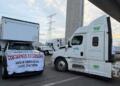
The national trucking strike on October 26 not only brought the grievances of the truckers to the forefront, but also raised a series of questions about the true scope of the mobilization, the reasons that led the sector to halt operations, and the involvement of the companies . Amid official statements, figures pointing to different scenarios, and organizations with differing positions, accounts emerged that did not always coincide regarding what happened on Mexican highways.
A protest over tax breaks?
The controversy gained momentum when President Claudia Sheinbaum stated during the morning press conferences on October 26 and 27 that the majority of transport workers were not mobilizing and linked the protest mainly to a tax modification that “would affect a small group of companies . ”
However, the leaders who spearheaded the strike maintained that the grievances went beyond taxes and included problems of insecurity , extortion , conditions that, they claim, affect their operations daily, and most worryingly, the deaths and violent robberies of operators.
Recently, representatives of the National Chamber of Freight Transportation (Canacar) indicated that around 15 operators had been murdered in the country during that year, of which three corresponded to Veracruz and two to San Luis Potosí, according to their respective delegations.
When T21 asked several business owners why criminal gangs have increased the level of violence, murdering their operators, the answer was emphatic: “They kill them because they know they are above the law, because they know the law cannot reach them, that it will embrace them,” said one of the business owners consulted.
This insecurity on the roads was one of the main demands of the members of the organizations calling for the strike, Canacar, the Mexican Federation of Transporters (FEMATRAC), the Honorable Mexican Alliance of Transport Organizations (HAMOTAC) and the Integrating Organization of Conventional Rights (INDECO).
“We cannot continue to tolerate more highway robberies, more loss of property, more murdered operators,” stated Lauro Rincón Hernández, national president of FEMATRAC.
In addition to the complaints about insecurity, there is the fear among operators and business owners of filing complaints due to possible reprisals, as well as the difficulties in recovering stolen units, even after they are located, situations that the leaders explained during the meetings following the mobilization.
Affecting only 170 companies
Speaking on the country’s highest platform, Claudia Sheinbaum stated during the morning press conference on October 26 that it was a “very small” sector and explained that the reduction from 300 to 250 million pesos in the billing limit to access a tax incentive for toll payments would only affect 170 companies.
The Ministry of Finance and Public Credit (SHCP) specified that, of the 2,580 taxpayers who use this benefit, 170 would stop receiving it in 2027 , while the remaining 94% would retain the incentive.
However, this figure corresponds to the companies, according to official figures, that were affected by the tax modification, not to the number of participants in the strike .

In contrast, carriers estimated, based on figures from the Ministry of Infrastructure, Communications and Transportation (SICT) from August 2026, that up to 6,996 medium and large companies could be excluded from the benefit. Their calculation considers 5,450 companies with fleets of 31 to 100 vehicles and 1,546 with more than 100 units, under the assumption that the incentive would cover companies with up to 30 tractor-trailer trucks.
The large companies in Canacar did not participate
On October 27, one day after the start of the national freight transport strike, President Claudia Sheinbaum Pardo reiterated that the majority of transporters had not participated in the mobilizations.
“Most truckers are not mobilizing. It’s a sector of Canacar,” he stated during his morning press conference. Even after meeting with members of Concamin, he emphasized: “The large companies in Canacar did not join in.”
This is indeed a truth that could be corroborated by T21, when consulting some of the companies with the largest vehicle fleet in Mexico and members of Canacar, it was confirmed that they were not part of the demonstration, and although some of their units were detected in some images, it was because they remained inside the blockades.
However, Augusto Ramos Melo, president of Canacar, emphasized that the benefits achieved from these demonstrations have an effect on all service providers, where freight transport represents about 3.8% of the Gross Domestic Product (GDP), so there will also be an effect on the national economy.
The organizations refused to participate in the dialogue tables
Although the federal government assured that it was keeping the channels of dialogue open with the trucking industry, the leaders who called for the strike pointed out that the working groups were not new and that the meetings held previously had not yielded the expected results .
Therefore, they demanded dialogue with high-level officials, with the capacity to make decisions and address the demands of the sector, particularly regarding road safety, extortion, and tax conditions.
On Sunday night, the president of HAMOTAC, Carlos García Álvarez, shared a video on social media in which he rejected participating in the dialogue tables proposed by the federal government, precisely because they would be held with second or third level officials, who did not guarantee results to their requests.
On Monday the 26th, at the invitation of the head of the Ministry of the Interior (Segob), the Secretary of Finance and Public Credit, as well as federal undersecretaries of Transportation and Security, were present and met with members of Concamin , ANTP , Canapat and Conatram .
Following the October 26th protests, representatives from Canacar, HAMOTAC, FEMATRAC, and INDECO reached an agreement with the Ministry of the Interior to establish working groups with various federal agencies, with defined deadlines and follow-up mechanisms. The leaders clarified that these meetings would be parallel to and independent of those held by other transportation organizations, although some demands might overlap.
The national strike ended on October 27, but the demands that led the transport workers to mobilize remained subject to the agreements reached with the Ministry of the Interior and the results of the working groups with the various federal agencies.
Leaders preliminarily estimated that it could take up to six months to see results, although they clarified that this was not a definitive timeframe. For now, the organizations remain hopeful that the commitments made will translate into concrete solutions to the problems of insecurity, extortion, and tax conditions that motivated the protest.
Comment and follow us on LinkedIn: @Karina Quintero / @GrupoT21