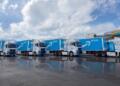
The rules began to change in California, USA, but for Bali Express Services, the path was already laid out. While regulatory pressure eased for private fleets to incorporate zero-emission vehicles , the carrier decided to maintain a strategy that began years ago and now finds in operational efficiency an additional reason to keep moving forward.
In September 2025, the California Air Resources Board (CARB) approved amendments to the Advanced Clean Fleets (ACF) regulation in the United States, which contemplate eliminating requirements applicable to private and federal fleets, including those corresponding to port haul trucks.
The change was also felt on the other side of the operation: the customers.
“The number one challenge was the lack of interest from customers,” said Juan Báez, CEO of Bali Express, in an interview with T21.
The equation has changed. While previously some customers were willing to pay more to have their goods transported in clean vehicles, now that difference is harder to pass on to customers. For Bali Express, the answer was to ensure its electric vehicles could compete not only on emissions but also on performance: making them as efficient as, or even more efficient than, a diesel or compressed natural gas (CNG) vehicle .
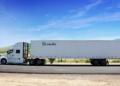
As the regulatory landscape shifted, the fleet continued to grow, and Bali Express placed an order for 60 Tesla tractor-trailers . The first 20 will arrive during the last quarter of 2026, and the remaining 40 during the first quarter of 2027.
The first unit is already in the company’s hands. With the new vehicles will also come something that until now had defined the limits of electrification: greater range. Báez indicated that they will have a range of up to 500 miles (about 805 kilometers) , which will allow for an expansion of the distances that electric operation can cover.
But putting an electric vehicle on the road doesn’t begin when the driver steps on the accelerator. The operation also depends on when and where to charge it .
In Southern California, Bali Express avoids charging its vehicles between 4:00 PM and 9:00 PM, the period when electricity rates are highest. This energy availability necessitates incorporating another variable into daily planning.
“It forces you to be more efficient. It forces you to plan your operation better,” Báez explained.
In return, the units offer telematic information on distance traveled, energy consumption and efficiency, allowing for a daily snapshot of their performance.
The company will also have an electric vehicle charging station in San Diego, California , which is scheduled to be completed between March and April 2027 and which, according to Báez, will significantly reduce energy costs.
A route that already crosses the border
The strategy already has a concrete track record between the United States and Mexico. The Green Trucking Corridor Long Beach-Tijuana combines electric and CNG-powered trucks to move goods between California and Baja California, a project that was recognized on June 25 by the Port of Long Beach.
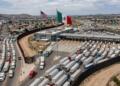
And the border doesn’t mean the end of the electric journey. The units enter Mexico and make deliveries to the maquiladora industry in Baja California.
The path, however, is further shortened when charging stations disappear. Báez acknowledged that outside of California, the lack of charging infrastructure limits the possibility of expanding these operations , one of the obstacles that greater autonomy seeks to begin reducing.
Meanwhile, suppliers linked to the Long Beach operation are already working on corridors that would connect the port to Phoenix, Arizona; and Las Vegas, Nevada .
California changed some of the rules that drove the transition. Bali Express, on the other hand, decided to maintain its route. Now the challenge will be to demonstrate that decarbonization can continue to advance even when it is no longer a requirement and must also be sustained through efficiency.
Comment and follow us on LinkedIn: @Karina Quintero / @GrupoT21