After a first half of the year marked by declining figures, July 2026 brought different signs for the heavy vehicle industry in Mexico. Production and exports increased compared to the same month last year, although the cumulative performance still reflects the effects of the contraction recorded during the first months of the year, reported Alejandro Osorio, Director of Public Affairs and Communication for the National Association of Bus, Truck, and Tractor-Trailer Manufacturers (ANPACT) .
During the seventh month of the year, 14,675 heavy vehicles were produced , an increase of 51.8% compared to the 9,668 units manufactured in the same month of 2025. Of the total, 14,319 corresponded to the cargo segment and 356 to the passenger segment .
The greatest growth was recorded in the passenger segment, whose production increased 80.7% compared to July of last year.
Despite the monthly increase, the cumulative total from January to July is still below the level recorded in 2015. In the first seven months of the year , 85,551 units were manufactured , a decrease of 6.1% compared to the 91,124 of the same period of the previous year.
Regarding the technologies used, production during July was almost entirely concentrated on Euro VI diesel units . No electric or natural gas vehicles were manufactured during the month.
Exports gain momentum
The most pronounced performance was observed in exports. During July, Mexico shipped 13,117 heavy vehicles abroad , a 66.7% increase compared to the 7,867 units exported in the same month of 2015.
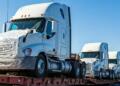
During the presentation of results, ANPACT highlighted the performance of tractor-trailer trucks , one of the main products within Mexican heavy vehicle exports.
The United States remained the main destination , with 9,374 units, followed by Canada with 436, and Colombia with 135. In the month, Mexico made shipments to nine countries, while in the accumulated January-July it reached 13 markets.
Among the destinations that registered the greatest variations were Colombia with an annual growth of 128%, and Peru with an increase of 220% . ANPACT attributed this performance to the efforts made to open and diversify export markets.
As with production, diesel vehicles accounted for the majority of exports during July, with 13,117 units exported under this technology.
Used, a pressure that continues
While production and exports showed better performance during July, ANPACT again focused on the import of used heavy vehicles from the United States , considering that their entry continues to affect both the established industry in Mexico and the carriers and the domestic market.
Between January and June, imports of these vehicles decreased by 30.4%. However, for every 100 new heavy vehicles sold in Mexico, an additional 53.4 used vehicles were imported .
The association noted that this flow has effects on employment, the production chain and domestic market prices, and is therefore holding talks with the Ministry of Finance and Public Credit (SHCP) and the Undersecretariat of Revenue to find mechanisms to contain it.
“A constructive, productive effort that we hope will bear fruit in the short term to provide a definitive solution to this problem affecting the industry,” Osorio said .
Comment and follow us on LinkedIn: @Karina Quintero / @GrupoT21