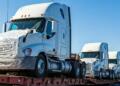
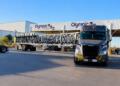
The Mexican heavy vehicle industry accelerated its production and exports during September 2016, with increases exceeding 100% in both indicators. However, this surge in manufacturing activity contrasts with the challenges facing the domestic market, particularly the importation of used vehicles, a problem on which the National Association of Bus, Truck, and Tractor-Trailer Manufacturers (ANPACT) has requested action from tax authorities.
According to figures presented by ANPACT, heavy vehicle production reached 15,181 units in the ninth month of the year, a growth of 121.4% compared to the 6,857 manufactured during the same month of 2025.
In the cumulative period from January to September , the plants established in Mexico produced 117,121 units, an advance of 10.3% compared to the 106,168 registered in the same period of the previous year.
The cargo segment accounted for the majority of manufacturing activity, with 114,443 vehicles produced during the first nine months of the year, a 10.4 percent increase. Of that total, 65,725 were tractor-trailer trucks, whose production increased by 11.5 percent, while the remaining cargo vehicles totaled 48,718 units, representing a 9.0 percent increase.
 Exports are growing, but remain below 2019 levels.

Export performance also showed a recovery during September, when Mexico shipped 12,707 heavy vehicles abroad, an increase of 144.6% compared to the 5,196 exported in the same month of 2025.
With this result, accumulated exports between January and September reached 98,394 units, a growth of 12.0% compared to the 87,816 registered during the same period of the previous year.
Of the total exported in the first nine months, 98,389 units corresponded to cargo vehicles, a segment that registered an increase of 12.1 percent.
Tractor -trailer trucks led exports, with 58,411 units and an annual growth of 16.4%, while the rest of the cargo vehicles totaled 39,978 units, an advance of 6.3 percent.
Despite these results, the recovery has not yet reached pre-pandemic levels. Compared to January-September 2019, cumulative production remains 26.9% lower , while exports show a negative difference of 26.4%.
In that period of 2019, Mexico had produced 160,149 heavy vehicles and exported 133,597 units, figures higher than those recorded during the first nine months of 2016.
![]() Imports of used vehicles continue to put pressure on the domestic market
Imports of used vehicles continue to put pressure on the domestic market

Although the import of used heavy vehicles registered a decrease of 30.7% between January and August 2026, its share compared to the sale of new units continues to be a challenge for the national industry.
According to ANPACT, during the first eight months of the year, 11,508 used heavy vehicles entered the country, compared to 16,614 registered in the same period of 2025.

The ratio also reflects the weight of these imports in the Mexican market. For every 100 new heavy vehicles sold, 51.6 used vehicles were imported between January and August 2026. While this ratio is lower than the 65.4 used vehicles for every 100 new ones registered throughout 2025, it remains above the levels of 2022 and 2023, when the ratio was 20.2 and 38.2 units, respectively.
Given this scenario, Rogelio Arzate, executive president of ANPACT, requested that the Ministry of Finance and Public Credit (SHCP) publish as soon as possible the reference prices to determine the customs value of imported used heavy vehicles, warning that their entry particularly affects micro, small and medium-sized transport companies that acquire units at retail.
Comment and follow us on LinkedIn: @Karina Quintero / @GrupoT21