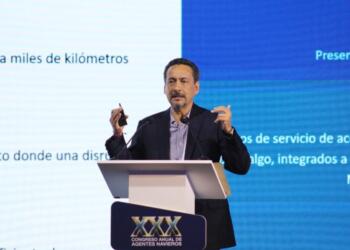
One hundred days after assuming the presidency of the National Chamber of Freight Transportation (Canacar) , Augusto Ramos Melo presented a work plan focused on four pillars: economic development, security, human capital, and institutional transformation , with the aim of strengthening the sector’s competitiveness and addressing the main challenges faced by carriers and operators in Mexico.
During his message, the leader stressed that freight transport moves more than 80% of the goods in the country and nearly 70% of the Gross Domestic Product (GDP) linked to products from sectors such as hydrocarbons, commerce, agriculture, agro-industry, mining and construction, making its operation strategic for the national economy.
“When the trucking industry advances, the national economy advances,” said Ramos Melo, who pointed out that these first 100 days are not enough to solve the challenges of the sector, but they are enough to define priorities and establish a work plan.
One of the main topics addressed was highway security . Based on figures from the Executive Secretariat of the National Public Security System (SESNSP) , between January and May 2016, 2,255 cargo truck robberies were recorded, a 17% decrease compared to the 2,707 cases reported during the same period in 2015. However, executives from Canacar (National Chamber of Freight Transportation) pointed out that there is a gap between official figures and the conditions reported by truckers on the highways, as many cases are not formally reported . In this context, Ramos warned that the statistical reduction is insufficient due to the persistent level of violence in these crimes.
Of the total robberies recorded in the first five months of the year, 1,289 involved violence and 966 did not. “We cannot normalize the loss of life on our roads. Every driver deserves to return home safely,” he stated.
The official explained that 93% of robberies are concentrated in 10 states : Mexico State, Puebla, San Luis Potosí, Guanajuato, Michoacán, Jalisco, Querétaro, Tlaxcala, Veracruz, and Hidalgo. Mexico State alone accounts for 30% of the incidents, followed by Puebla with 15%.
Regarding the type of merchandise , Canacar identified that 57% of the stolen products correspond to hydrocarbons, medicines, medical supplies, cleaning products, chemicals and footwear; while 32% correspond to food and groceries.
Given this situation, the agency reported that it has reinforced its 24-hour call center and launched an alert and assistance center for victims of crime on highways, with the purpose of providing support to affiliated companies and operators.
In its first 100 days, the agency handled over a thousand calls, 45% of which were related to state, federal, or municipal traffic stops. It also received 342 reports of theft, 59 of which resulted in the recovery of stolen goods.
Ramos Melo noted that Canacar participates in working groups with federal and state authorities , in addition to collaborating with the National Guard and prosecutors’ offices. However, he insisted on the need for more decisive action , a greater security presence in high-crime areas, and investigations to combat criminal groups.
“Security cannot be measured solely in numbers; it must be measured in lives protected,” he emphasized.
Another commitment of the administration is to promote safe, comprehensive rest stops . Ramos recalled that during his inauguration he set a goal of establishing 30 such rest stops in his first year in office. One hundred days into his term, he reported that 10 projects have been approved and have already received a favorable technical opinion from the Ministry of Infrastructure, Communications and Transportation (SICT) , in addition to other applications currently being processed.
The leader explained that this infrastructure is necessary to reduce risks associated with fatigue, improve rest conditions for operators, and strengthen the security of supply chains.
In terms of human capital , the agency is also working on programs to incorporate women into the trucking industry. Ramos indicated that, according to SICT data, of the 711,000 federal licenses registered in the first half of 2026, only 1% belong to women.
The National Chamber of Freight Transportation (Canacar) is collaborating with the German agency GIZ and automotive manufacturers to promote scholarships and training for female truck drivers. Claudia Sánchez Porras, Canacar’s general director, explained that the program will begin with groups of 15 to 20 women, with company support to directly monitor their training and operations.
Canacar is also looking to recruit Spanish-speaking Latin American migrants in Mexico who are seeking employment. While Ramos clarified that they don’t yet have an official count of how many migrants have joined the driving force, he noted that they are already working on integrating them through training centers, including one recently opened in Puebla.
In terms of vehicle renewal , the agency supported the heavy vehicle replacement and modernization program promoted under the Mexico Plan , administered by the SICT and Nacional Financiera (Nafin) . The program includes 70% shared guarantees for new and used vehicles, aimed at micro and small transport operators with fleets of one to 30 units.
Ramos explained that the loans can be for up to 15 million pesos (MXN), with terms of up to 84 months for new vehicles and up to 60 months for used vehicles. The minimum down payment will be 10% for new vehicles and 15% for used vehicles.

The leader noted that the average age of the fleet in Mexico is 19 years , a figure he considered alarming compared to other markets. He indicated that, to approach international standards, approximately 50% of the fleet would need to be renewed.
In this context, Canacar is also working with federal authorities on a program to destroy scrap vehicles and on measures to curb the importation of used vehicles that, according to Ramos, do not have the proper configurations to operate in Mexico. He added that, together with the industry, they are seeking a minimum tariff of 50 percent for these imported vehicles .
Regarding operating costs, Ramos reported that the national freight transport sector incurred an additional expense of 22.015 billion pesos in 2025 due to the increase in fuel prices. He emphasized that diesel continues to be one of the main components of the sector’s cost structure.
Although he acknowledged that the impact in Mexico was less than that observed worldwide, where the increase reached up to 20%, he highlighted the importance of the incentives for the Special Tax on Production and Services (IEPS) and the efforts to keep the price of diesel below 27 pesos per liter.
Furthermore, he warned that the sector requires certainty in the supply of ultra-low sulfur diesel , essential for units with recent technologies and to contribute to the reduction of polluting emissions.
In terms of infrastructure , Canacar identified shortcomings in the conservation and maintenance of state, municipal, and toll-free federal highways. Ramos noted that the 2025-2030 National Development Plan and the sectoral plan acknowledge that only one-third of the toll-free federal highway network is in optimal condition, with a goal of raising this figure to 80% by 2030.
The president of Canacar pointed out that the physical condition of the roads directly impacts operating costs, road safety, and logistical efficiency . While in other countries logistics costs represent between 8% and 10% of the value of goods, in Mexico they can reach up to 20%.
Canacar is also working on mapping sections with the greatest infrastructure problems , supported by information from operators and carriers, with the aim of generating technical data that will allow prioritizing investments.
In ports and customs facilities , Ramos explained that an average of 15,000 operators face excessive waiting times daily at the country’s main logistics points, often under hot conditions, lack of rest areas and absence of basic services.
At the northern border, he asserted that around 19,000 crossings are registered daily, but the inspections and lines have generated delays that, at critical times, reach more than 20 kilometers.
Canacar is maintaining contact with Texas DOT to build a binational, data-driven scheme that will improve the flow of goods and protect the integrity of operators.
Regarding the Maya Train , Ramos reported that a first test run to transport cargo on the rail lines will take place in August, with the goal of beginning passenger and freight traffic simultaneously by the end of this year or the beginning of next year. He explained that the trucking industry sees an opportunity to participate in last-mile delivery , primarily in the transport of hydrocarbons, food, and supplies to areas such as Cancún and the Port of Progreso.
Regarding the 40-hour workweek , Canacar (the National Chamber of Freight Transportation) believes that the trucking industry requires special consideration due to the nature of its operations. Ramos indicated that, although NOM -087 ( the Mexican Official Standard for Driving and Rest Times) exists, the sector needs safe infrastructure where drivers can take breaks.
“Fifty percent of robberies occur when we stop to eat, use the restroom, or sleep,” he warned. He insisted that safe rest stops are impossible without adequate rest areas.
Regulation, data and institutional strengthening
Regarding regulations, Canacar expressed its concern about the new traffic regulations that expand the National Guard’s supervisory and enforcement powers. It noted that the sector was not consulted during their drafting. Ramos said the chamber is working on a technical report to assess the impact of these provisions and to establish working groups with federal authorities.
The agency is also collaborating with the SICT on the new towing regulations, with the goal of improving service quality, establishing clear rules, and combating excessive charges. It also announced the availability of a hotline for reporting abuses.
In its institutional transformation , Canacar launched tools such as Canacar 360, Canacar Integra and Canacar Data, aimed at improving internal management, tracking requests, managing member information and building its own statistics for decision-making.
During its first 100 days, Canacar reported 104 institutional meetings and working sessions with authorities, legislators, trade organizations, and agencies such as the SICT, the Ministry of Economy , the Attorney General’s Office (FGR) , the Mexican Social Security Institute (IMSS), and the National Customs Agency of Mexico (ANAM) . It also held 29 meetings of specialized commissions and committees, signed new collaboration agreements, offered 12 training courses, and provided instruction to 1,626 people.
Among the recent agreements, he mentioned collaborations with Cummins , Samsara , Daimler , PASE , Solvento and the National Association of Vehicle Tracking and Protection Companies (ANERPV) , in addition to alliances such as with the Mexican Transportation Institute (IMT) , the National Autonomous University of Mexico (UNAM) and the National Polytechnic Institute (IPN) to strengthen the generation of data, technical diagnoses and sectoral information.
“What is not measured cannot be improved,” he argued.
At the close, the president of Canacar assured that these first 100 days represent only the first step of a work path that demands unity and results for the sector.
“Because when trucking advances, the national economy advances,” he stated.
Comment and follow us on LinkedIn: @Karina Quintero / @GrupoT21