When work decreases, investment decisions also become tighter; for owner-operators and small businesses , adding another unit to the fleet means allocating resources that need to be returned to the operation in the form of kilometers and income, so a lower level of activity also ends up curbing the purchase of vehicles.
This reality now affects both the new and used truck markets. Arturo Gómez, director of SARMW —a firm specializing in leasing, sales, and maintenance services for the transportation industry—explained that the decrease in activity among some of its clients has restricted purchases, particularly among owner-operators and small businesses, the company’s main target segments.
The segment in question has a significant weight within the sector. As of June 2026, micro-enterprises with between one and five units represented 79.8% of federal freight transport companies , totaling 182,347 companies and 341,155 vehicles, according to data from the General Directorate of Federal Motor Transport (DGAF) of the Ministry of Infrastructure, Communications and Transportation (SICT) .
According to Gómez, part of the pressure this market faces is related to the dynamics of these carriers themselves, whose business may depend on supplemental work from larger companies. When that volume decreases, the possibility of adding another vehicle is also restricted.
He commented that they are looking to join the operation without the buyer having to allocate additional resources immediately.
Logic becomes relevant in a segment particularly sensitive to working capital. Arturo Gómez explained that most of these units are acquired through financing , so buying a vehicle that then remains out of service due to a breakdown can become an additional burden for the carrier.
“If you deliver a unit of very good quality, in very good condition, even though it is a second-hand unit, you guarantee that it will not lose capital and will start generating profits. So, that’s what we’re betting on,” he said.
Although cost remains a determining factor when buying a used car, for Gómez the decision now involves more elements: quality, support, warranty, financing and, particularly, that the chosen vehicle corresponds to the operation that will be carried out.
“Price is important, but if you offer a quality product, provide financial support, and can also advise the customer on choosing the right unit for their application, you definitely have a winning offer,” he stated.
Purchasing behavior also has its own timeline. Among owner-operators and small businesses served by SARMW, acquiring a second unit can take more than six months , while the carrier raises the necessary capital again.
This is where after-sales support becomes crucial for the company. Gómez stated that most of their customers return and explained that during this period they strive to maintain support so that, when the buyer has the capacity to purchase another vehicle, they will return to the company.
But behind the second-hand market there is also another need: to replace vehicles that have been in operation for years when buying a new one remains out of reach for some transporters.
“It’s very difficult for a truck driver to acquire new equipment,” he acknowledged. Given this reality, SARMW aims to offer newer model year and refurbished units, as well as financing options that allow carriers to leverage their existing equipment and reduce the initial outlay.
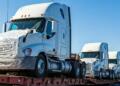
The company’s offering primarily consists of tractor-trailer trucks from 2007 to 2019 or 2020 models , as well as dump trucks, short- and long-haul vehicles, and various sleeper configurations. It has also begun releasing trailers from its rental pool to complement its powertrain and trailer inventory.
SARMW has approximately 100 trucks in its inventory for sale , of which 25 to 30 have already been refurbished to the company’s standards . These units come primarily from the group’s own operations, in addition to acquired equipment that is subsequently refurbished before being returned to the market.
This year, the expectation is to move between 70 and 80 trucks , compared to an ideal scenario of between 120 and 150 units annually, Gómez commented.
The company is also looking to expand its reach beyond the northeast of the country, where a large portion of its customers are currently concentrated. Gómez noted that they operate a sales point in the Mexico City metropolitan area, have locations in Querétaro, recently opened a location in Chihuahua, and are looking to expand into the southeast of the country.
SARMW Truck Fest 2026, from pre-owned to business
Part of that commercial strategy took shape on August 13 during the SARMW Truck Fest 2026 , held in Allende, Nuevo León, a meeting designed to bring together in one space customers, suppliers and allies around the purchase of units and the solutions that accompany their operation.
Prior to the meeting, SARMW expected the attendance of more than 250 registered clients and planned to turn the activity into a transactional event, that is, that attendees would not only learn about the vehicles, but could also complete transactions during the day.
The offerings weren’t limited to trucks. Suppliers and partners participated with solutions, spare parts, and benefits for carriers, in addition to activities and raffles throughout the event. The Truck Fest itself featured pre-owned tractor-trailers, transportation equipment, promotions, consulting, and financing options.

SARMW also brought together its commercial, technical and operations teams, as well as financial support, during the event, with the intention that a customer could find a unit, review credit alternatives and move forward with the transaction all in one place.
And some units ended the day changing hands. Among the transactions carried out during Truck Fest were the delivery of units to carriers from the region, as well as from Durango, Veracruz, the Bajío, central, and southeastern Mexico .


Thus, in a year where the market demands careful consideration of every investment decision, SARMW is betting that the used truck is not just the truck that someone else stopped using, but an asset that can return to the road, start producing, and become a renewal alternative for those who still find the possibility of owning a brand-new unit far off.

Comment and follow us on LinkedIn: @Karina Quintero / @GrupoT21