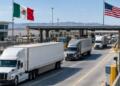
In a context of uncertainty marked by the review of the United States-Mexico-Canada Agreement (USMCA) , scheduled for July of this year, variable tariffs, and possible internal reforms in the country—such as electoral reform—the manufacturing industry in Tijuana is showing resilience, with water infrastructure and border logistics projects , along with binational initiatives to strengthen the Cali-Baja region, which seek to attract and retain investment, especially for advanced manufacturing
For the industrial sector of the border city, the United States and Mexico share a region, such as Cali-Baja, which has its own commercial dynamics and particular activity, so it is necessary to take care of it and continue to make it grow.
“It is a region that cannot be understood in any other way than through a joint dynamic. It is two countries in a single region,” highlighted Alonso Ibarra Arellano, president of the National Chamber of the Transformation Industry (Canacintra) Tijuana , in an interview with T21.
Ibarra, who assumed the presidency of the organization on February 5, has proposed the creation of a Binational Industrial Council as part of the restructuring of Canacintra Tijuana, which brings together 400 members, with the purpose of providing greater certainty to investors , while seeking a common agenda with US counterparts in the Cali-Baja area.
Among the council’s tasks is identifying shared interests, from products manufactured in Tijuana that are exported to the United States, to attracting foreign capital through the relocation of companies, that is, nearshoring .
“We have to understand that we are in this together, that if something happens on the United States side, it affects us in the manufacturing industry, and vice versa, what happens in Tijuana and Baja California affects them, so the best thing is to come together, sit down and defend it,” Ibarra Arellano said.

The Cali-Baja region, made up of the counties of San Diego and Imperial in the United States, and Baja California in Mexico, has consolidated itself as one of the most important areas for the process of reconfiguration of supply chains in North America .
In 2024, San Diego and Imperial counties exported $34.5 billion , 97% of which went to the Mexican market. These exports supported approximately 95,000 jobs in critical industries such as aerospace, medical devices, and semiconductors, according to the 2025 Binational Trade & Competitiveness Report , prepared by the World Trade Center San Diego .
Meanwhile, the same study noted, Baja California exported $55 billion worth of goods during the same year, with 98% being manufactured goods and 95% destined for the United States.
Factors such as specialized manufacturing in Mexico and research activities, as well as high-tech development and services in San Diego, have triggered a highly integrated binational ecosystem.
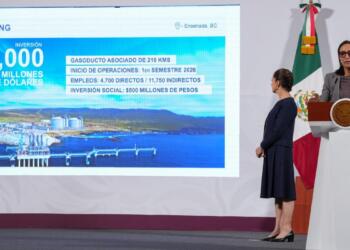
One of the projects being prepared in Baja California for a new growth cycle with investments in critical infrastructure is the Rosarito desalination plant project , announced by the state government, which will help solve part of the water deficit that affects both the population and the manufacturing industry.
“Right now we are analyzing the financing that will be used, the debt that the state government will incur for this project. It is a project that managed to obtain federal resources for its implementation,” Ibarra Arellano recalled.
The plant will have a capacity of 2,200 liters per second and will increase the water supply for Tijuana, Playas de Rosarito and Ensenada by up to 45%, and will have an estimated investment of four billion pesos (mdp) from the state government and 10 billion pesos from the Federation.
Ibarra also spoke about the progress of the additional Otay Mesa II border crossing, which is progressing well on the Mexican side, while on the United States “we are in negotiations with the United States authorities to see when it will be completed on the other side of the border, because it is something that will help us with customs logistics .”
According to studies by the San Diego Association of Governments (SANDAG) , the new border crossing is projected to reduce wait times by up to 50% on average, which could generate a significant increase in the value of regional bilateral trade .
USMCA with caution
Facing the USMCA review, Ibarra maintains an optimistic outlook for Tijuana’s industry, but also expresses caution
“Ideally, we would like to reach an agreement that provides certainty for another 16 years, but we are confident that even if we do not reach one by July, we will still have a USMCA, since the agreement does not disappear, but rather undergoes annual reviews.”
With a long-term water project, optimized logistics, and a shared binational vision, Tijuana is positioning itself as a preferred destination for nearshoring and strengthening trade between Mexico and the United States. According to the U.S. Census Bureau , in December 2025, Mexico consolidated its position as the main trading partner of its northern neighbor, registering an exchange of goods worth $70.521 billion .
Comment and follow us on LinkedIn: @Humberto Cruz Moya / @GrupoT21