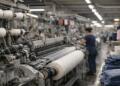
At the inauguration, Rafael Zaga Saba , president of Canaintex, emphasized that the Mexican textile industry “is not a minor industry, but a force that transforms national raw materials into value, identity and future for more than one million Mexican families.”
The business leader warned that the sector is facing one of the most challenging periods in its recent history, with 10 consecutive quarters of declining textile manufacturing, job losses, and reduced production capacity. Even so, he insisted that it is a vibrant, strong industry with a future, generating more than 1.1 million jobs.
“We refuse to be a sector that only manufactures or labels. Behind every thread, every fabric, and every garment there is history, talent, and commitment to this country,” Zaga Saba emphasized.
A call to consume products made in Mexico
During his speech, the president of Canaintex urged consumers to “turn the label over” and choose products made in Mexico, as an act of trust and support for the national economy. He also asked manufacturers to strengthen their use of domestically produced cotton, fibers, yarns, and fabrics, and to maintain their production chains with strategic partners in the region.
“The recovery will not come from outside, but from the sum of our own decisions,” he emphasized.
Zaga Saba warned that smuggling and the misuse of programs continue to undermine fair competition within the sector, although he acknowledged the federal government’s efforts to close loopholes for illegal activity. He celebrated the approval of the new Customs Law, which excludes Strategic Bonded Warehouses in sensitive sectors, a measure that “ marks the beginning of a fairer and more transparent environment .”
He also highlighted the stance of President Claudia Sheinbaum, who has reiterated that smuggling will not be tolerated and that the country must prioritize national content and import substitution.
The president of Canaintex urged manufacturers to work together with the Federal Government to eradicate bad trade practices and strengthen the domestic market, as a key strategy in the face of the 3.8% drop in manufacturing GDP in the second quarter of 2025.
“With joint actions by the government, industry, and businesses, the landscape of the value chain can change. Strengthening public finances and improving conditions for honest entrepreneurs is a win-win for Mexico,” he stated.
Zaga Saba concluded her remarks by highlighting that the textile industry is the most integrated in the country, “the one that is born in the countryside and proudly reaches the shop window,” and acknowledged that both President Claudia Sheinbaum and Secretary of Economy Marcelo Ebrard “see ‘Made in Mexico’ not as a slogan, but as a vision for the country.”
“When this industry unites, Mexico becomes stronger. We have reasons to believe, reasons to unite, and the strength to build the future our industry deserves,” he said.
Comment and follow us on X: @GrupoT21